
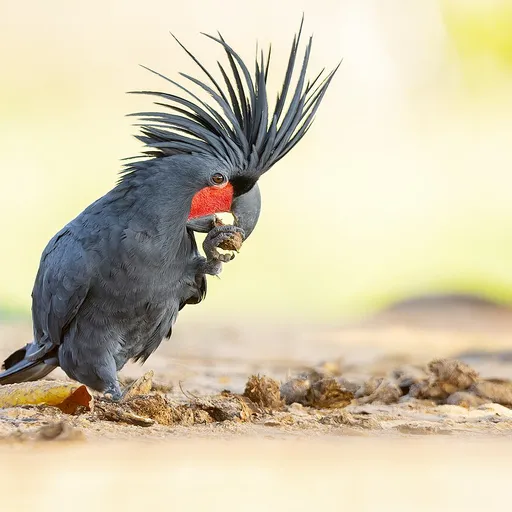
Palm Cockatoo
Probosciger aterrimus
Near Threatened
Overview
The palm cockatoo, also known as the goliath cockatoo or great black cockatoo, is a large parrot native to New Guinea, the Aru Islands, and Cape York Peninsula in Queensland, Australia. It is classified as Near Threatened on the IUCN Red List.
Identification
- Length of 55 to 60 cm and weight of 910–1,200 g, potentially making it the largest parrot in Australia.
- Plumage is smoky-grey to black, featuring a large crest and prominent bright-red cheek patches that change colour when the bird is alarmed or excited.
- Possesses one of the largest and strongest bills of any parrot, sharply hooked and black, with a unique structure where the upper and lower mandibles do not meet for much of their length.
- Males have larger beaks than females and produce complex vocal sequences, distinct from other regional populations due to long-term isolation.
Habitat
This species inhabits rainforests and woodlands across New Guinea, the Aru Islands, and Cape York Peninsula in Queensland, Australia. It can still be found near Sorong, West Papua, Indonesia, where it is sometimes observed in trees along roads.
Diet
The palm cockatoo feeds mostly on wild pandanus palm fruits and kanari tree nuts, supplementing its diet with fruits from the Darwin stringy bark and nonda trees, as well as seeds from the cocky apple, beach almond, and black bean tree. Foraging often occurs in the early hours of the day, with groups typically consisting of only one to six individuals.
Did you know?
The palm cockatoo is one of the few bird species known to use tools, fashing individual musical tools from wood and seed pods to drum out highly personal rhythms against trees to mark territory and attract mates.
Sources
- Wikipedia · CC BY-SA 4.0
- Wikidata · CC0 1.0