
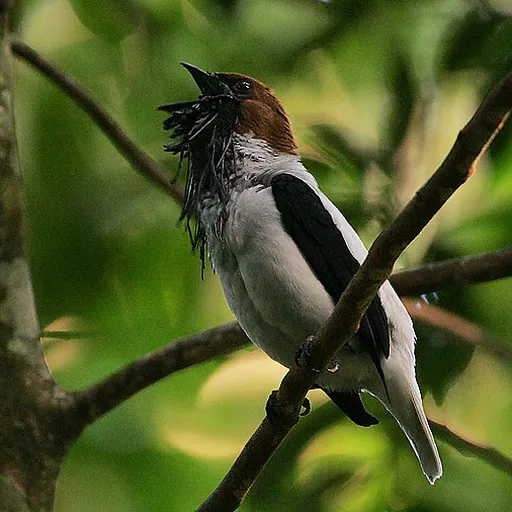
Bearded Bellbird
Procnias averano
Near Threatened
Listen
XC854960 · steve · Blanchisseuse, Tunapuna/Piarco Regional Corporation, Trinidad & Tobago · CC BY-SA 4.0
Overview
The bearded bellbird (Procnias averano), also known as the campanero or anvil-bird, is a passerine bird found in northern South America. It is classified as Near Threatened on the IUCN Red List.
Identification
- Males are approximately 28 cm long with white plumage, a warm brown head, black wings, and black stringy wattles hanging from the throat.
- Females are smaller, featuring olive-green upperparts, yellow underparts streaked with green, and a yellow vent area, lacking the male's facial wattles.
- Both sexes possess dark eyes, a black bill, and grey to black legs.
- Males produce a loud, dull 'Bock' call every few seconds and a metallic 'tonk-tonk-tonk-tonk' sound resembling a hammer hitting an anvil, which is repeated 20–30 times.
Habitat
This species occurs in humid forests and woodland in Venezuela, adjacent parts of Colombia and Guyana, Trinidad and Tobago, and northeastern Brazil. While mainly resident, some populations undertake altitudinal migrations, breeding at heights of up to 1,900 m and spending the non-breeding season in the lowlands.
Diet
These arboreal birds feed entirely on fruit and berries, mainly taken on the wing, with a particular preference for Lauraceae, Burseraceae, Araliaceae, and Melastomataceae. The female feeds the young regurgitated Lauraceae.
Did you know?
The male is polygamous and spends much of his time advertising with his distinctive songs, leaving the female to incubate the single egg solely and build the nest.
Sources
- Wikipedia · CC BY-SA 4.0
- Wikidata · CC0 1.0