
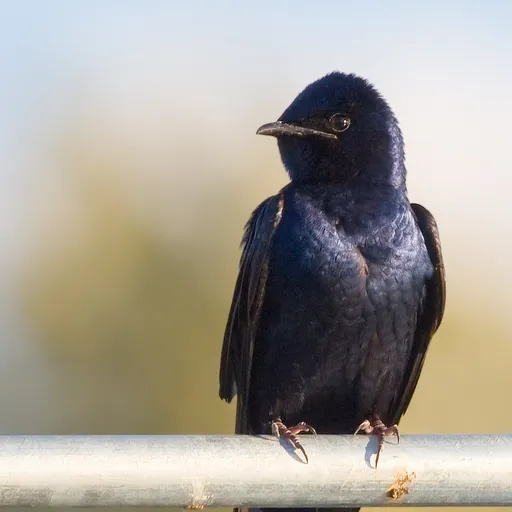
Purple Martin
Progne subis
Least Concern
Overview
The purple martin (Progne subis) is a passerine bird in the swallow family Hirundinidae, notable as the largest of the approximately 90 species within that family in North America. It is characterised by its speed, agility, and a distinctive flight pattern that mixes rapid flapping with gliding.
Identification
- Plumage: Adult males are entirely black with a glossy steel blue sheen, a colour unique among North American swallows; females are dark on top with some sheen and lighter underparts.
- Size: Average length is 20 cm with a wingspan up to 38 cm, making it the largest swallow in the region.
- Tail: Adults possess a slightly forked tail.
- Vocalisation: The species is vocal, producing calls described as throaty and rich, including chirps, chortles, and croaks, with males exhibiting a gurgling courtship song.
Habitat
Breeding occurs across temperate North America, including eastern and southeastern North America, the coastal Pacific Northwest, and parts of Mexico, while the species overwinters in the Amazon basin and parts of South America east of the Andes. In the eastern United States, the species is largely dependent on human-provided nesting structures such as artificial gourds or houses, often breeding in colonies near human settlements, whereas western populations frequently utilise natural cavities like old woodpecker holes or saguaro cacti.
Diet
Purple martins are insectivores that primarily hawk for insects in flight, though they rarely come to the ground to feed. Contrary to popular belief, mosquitoes do not constitute a large part of their diet, although research indicates they do feed on invasive fire ants, which may make up a significant portion of their consumption.
Did you know?
The specific epithet subis is derived from a Latin name for a bird mentioned by the Roman author Nigidius Figulus that was said to be capable of breaking eagles' eggs, a reference likely applied to this species due to its aggressive behaviour towards birds of prey while nesting.
Sources
- Wikipedia · CC BY-SA 4.0
- Wikidata · CC0 1.0