
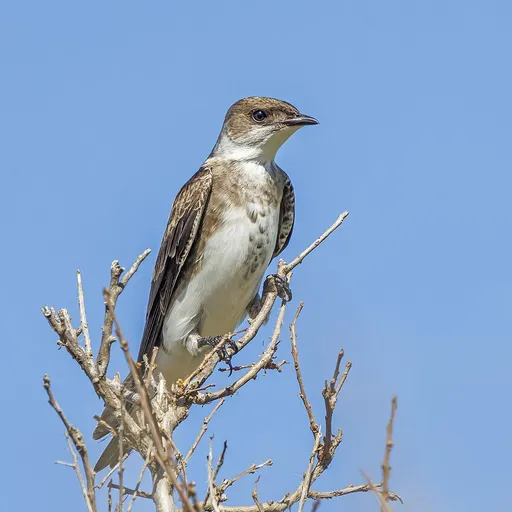
Brown-chested Martin
Progne tapera
Least Concern
Overview
The brown-chested martin (Progne tapera) is a passerine bird in the family Hirundinidae, commonly found across Central and South America. It is classified as a species of Least Concern by the IUCN, with an extremely large range and an estimated population of at least fifty million mature individuals.
Identification
- Adults are 16 to 18 cm long with a sandy brown head, upperparts, and a slightly forked tail that is darker brown than the upperparts.
- Underparts are mostly white, featuring an indistinct brown band across the breast, while the chin and throat are white.
- The nominate subspecies has a less defined breast band, whereas subspecies P. t. fusca is larger, darker, and has a more defined breast band with dusky markings on the lower breast and belly.
- The song consists of harsh, guttural, descending trills described as 'trr-tee-tuk-TEEERRR', accompanied by dry, buzzy calls.
Habitat
This species inhabits semi-open to open landscapes such as grasslands, cultivated areas, forest clearings, and human settlements, typically favoring locations near water. Its range covers Panama and mainland South America east of the Andes, extending as far south as Argentina, with the nominate subspecies also found in parts of western South America.
Diet
The brown-chested martin feeds on a wide variety of insects captured in mid-air, with some populations consuming primarily winged ants and termites. It forages singly or in small flocks, flying fast and low over vegetation and water, or higher when feeding on swarms of flying ants.
Did you know?
Subspecies P. t. fusca forms massive flocks during migration and in its winter range that can exceed 100,000 individuals. Additionally, large flocks roosting on buildings are sometimes considered a nuisance by local human inhabitants.
Sources
- Wikipedia · CC BY-SA 4.0
- Wikidata · CC0 1.0