
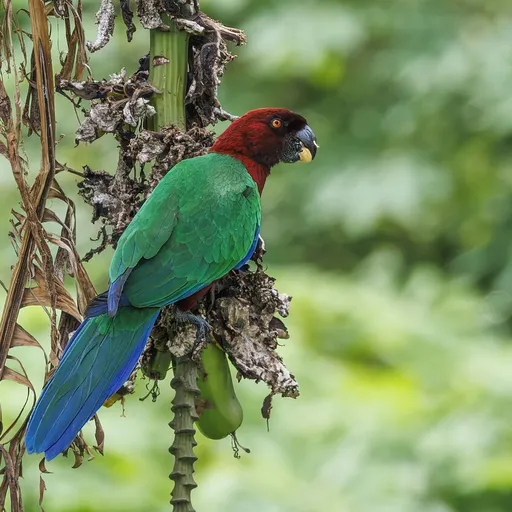
Maroon Shining Parrot
Prosopeia tabuensis
Least Concern
Overview
The maroon shining parrot (Prosopeia tabuensis) is a species of parrot native to the islands of Vanua Levu and Taveuni in Fiji, and was introduced to southern Tonga in prehistoric times. It currently lives in subtropical or tropical moist lowland forests and mangroves, and is classified as Least Concern by the IUCN Red List.
Identification
- Plumage: Variable adult plumage featuring a red and black face, a brown or red head, and dark maroon underparts.
- Markings: A dark blue collar runs across the upper mantle, which is sometimes narrow or nearly absent, while the upperparts and tail are green.
- Bill and Legs: The bill is grey to black, accompanied by a dark grey eye ring and orange or yellow eyes.
- Vocalisation: Calls consist of high-pitched nea-nea and arr sounds repeated in bursts, along with other squawks and hoots, most frequently heard at night.
Habitat
Native to Fiji and prehistoric introductions to Tonga, the species is found in mature and secondary growth forests, forested valleys, coconut plantations, village gardens, farmlands, mangroves, and scrub. It inhabits subtropical or tropical moist lowland and mangrove forests, often appearing alone, in pairs, or in flocks of up to 40 individuals.
Diet
This parrot primarily feeds on the seeds and fruits of various forest trees, including mango, guava, banana, and papaya. It occasionally consumes insect larvae or raids cornfields, using its strong bill to bite into wood to extract insects or larvae. Food is held in its feet to allow the bill to manipulate and access the material.
Did you know?
In Tonga, the bird is known as the Koki because of the distinctive sound it makes, which has historically been the basis for its local name. Although originally introduced via eighteenth-century trade, the species is now restricted to the island of ʻEua in Tonga.
Sources
- Wikipedia · CC BY-SA 4.0
- Wikidata · CC0 1.0