
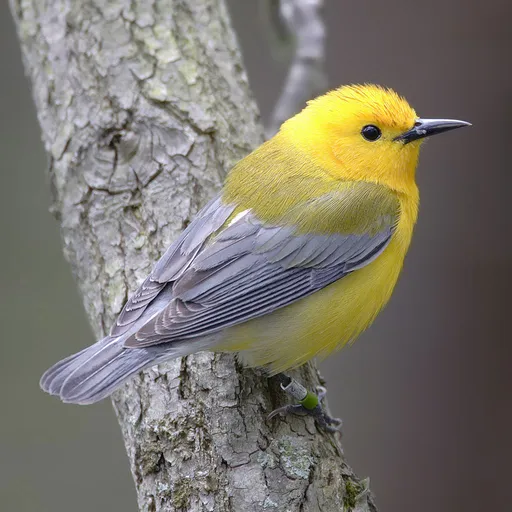
Prothonotary Warbler
Protonotaria citrea
Least Concern
Listen
XC311810 · Tom Austin · Anderson, Anderson County, South Carolina, United States · CC BY-SA 4.0
Overview
The prothonotary warbler (Protonotaria citrea) is a small New World songbird and the sole member of the genus Protonotaria. It is notable as the only eastern warbler that nests in natural or artificial cavities.
Identification
- 13 cm long with a mean weight of 14.3 g and a 22 cm wingspan.
- Olive back, blue-grey wings and tail, yellow underparts, relatively long pointed bill, and black legs.
- Adult males possess a bright orange-yellow head, whereas females and immature birds have duller, yellow heads.
- A distinctive two-toned tail in flight, appearing white at the base and dark at the tip when viewed from below.
- Simple, loud, ringing song described as "sweet-sweet-sweet-sweet-sweet" and a loud, dry chip call.
Habitat
Breeds primarily in hardwood swamps in extreme southeastern Ontario and the eastern United States, though it may also nest near creeks, streams, ponds, and swimming pools. During winter, it resides in mangrove swamps across the West Indies, Central America, and northern South America.
Diet
Forages actively in low foliage within dense, woody streams, feeding mainly on insects and snails.
Did you know?
The species became a pivotal part of US political history during the Hiss-Chambers hearing, where its sighting on the Potomac River was used by Richard Nixon to expose a contradiction in Alger Hiss's testimony regarding his acquaintance with Whittaker Chambers.
Sources
- Wikipedia · CC BY-SA 4.0
- Wikidata · CC0 1.0