
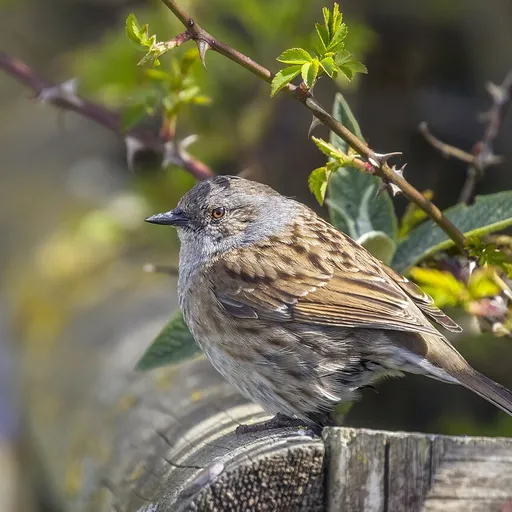
Dunnock
Prunella modularis
Least Concern
Listen
XC730527 · Sonothèque ADVL · Bréhal, Manche, Normandie, France · CC0 1.0
Overview
The dunnock (Prunella modularis) is a small passerine bird found throughout temperate Europe and into Asian Russia, as well as in New Zealand where it was introduced. It is the most widespread member of the accentor family and is characterised by its drab appearance which likely evolved as camouflage.
Identification
- Brown back streaked blackish and brownish underneath, resembling a small house sparrow in its drab, inconspicuous appearance.
- Typically measures 13–14.5 cm in length with a fine pointed bill and a dull grey head in adults.
- Exhibits frequent wing flicking, especially during territorial disputes, earning it the nickname "shufflewing".
- Produces a shrill, persistent tseep call and a rapid, thin, tinkling warble.
Habitat
Native to large areas of Eurasia and introduced to New Zealand, dunnocks inhabit temperate lowland areas including woodlands, shrubs, gardens, and hedgerows. They are the only accentor commonly found in temperate lowlands, as others are restricted to upland or subarctic regions.
Diet
Dunnocks typically feed on the ground, often seeking out detritivores as food.
Did you know?
Dunnocks possess variable mating systems, with polyandry being common, leading to sperm competition where males may peck at a female's cloaca to stimulate the ejection of rival sperm. Males do not necessarily gain exclusive paternity from sharing a territory, as reproduction is often shared equally among group males.
Sources
- Wikipedia · CC BY-SA 4.0
- Wikidata · CC0 1.0