
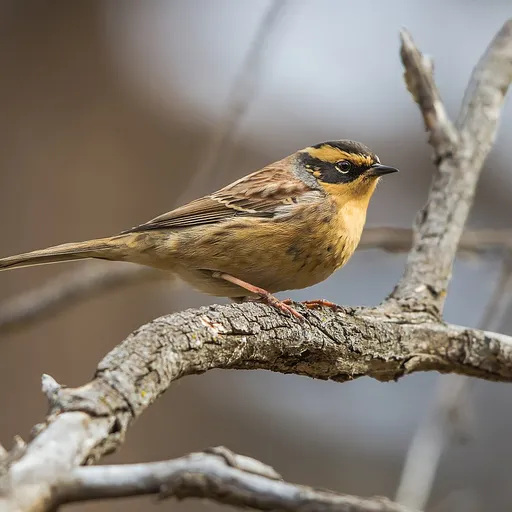
Siberian Accentor
Prunella montanella
Least Concern
Overview
The Siberian accentor is a small passerine bird that breeds in northern Russia and winters in Korea and eastern China. It is generally classified as a species of least concern by the IUCN, though it may face long-term threats from climate change.
Identification
- Measures 14.5 cm in length and weighs 17.5 g, featuring brown upperparts with bright chestnut streaking on the back.
- Distinctive head markings include a dark brown crown, a long, wide pale yellow supercilium, and a blackish patch behind the eye.
- Underparts are ochre yellow, becoming strongly buff on the flanks with rich chestnut streaks on the sides of the breast.
- The call is a trisyllabic ti-ti-ti, and the male's song is a loud, high chirichiriri sung from the top of a bush or tree.
Habitat
Breeds in subarctic willow and birch forests, open coniferous woodland, and spruce taiga, often close to water, rivers, or bogs. In winter, it occupies bushes and shrubs frequently near streams, though it may also be found in dry grassland and woods. Its breeding range spans a belt across northern Russia from the Ural Mountains to the Pacific coast, extending south to the Sea of Okhotsk.
Diet
Feeds mainly on insects picked off the ground, from vegetation, or near snow fields, with young birds primarily consuming beetle larvae. In winter, the bird may consume seeds from plants such as crowberry, bistort, and members of the amaranth and birch families, and may also feed near human habitation.
Did you know?
An unprecedented influx of Siberian accentors into western Europe in October and November 2016 reached the United Kingdom, likely driven by strong easterly winds and birds avoiding the smoke from widespread Siberian forest fires. This event saw hundreds of birders and national attention, with one bird lingering in Scotland until February 2017.
Sources
- Wikipedia · CC BY-SA 4.0
- Wikidata · CC0 1.0