
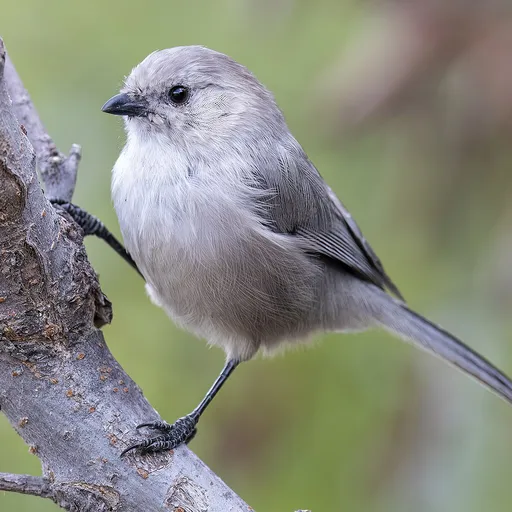
American Bushtit
Psaltriparus minimus
Least Concern
Overview
The American bushtit (Psaltriparus minimus) is a social songbird and one of the smallest passerines in North America, belonging to the monotypic genus Psaltriparus. As the only species in the family Aegithalidae found in the Americas, it is characterised by its tiny size and large, plump head.
Identification
- Measures 100–110 mm in length and weighs between 4.5–6 g, featuring a large head, short neck, and long tail.
- Plumage is primarily grey-brown, with regional variations including a brown cap in coastal birds and a brown mask in inland populations.
- Males possess dark brown to black eyes, whereas adult females have yellow eyes.
- Some subspecies, particularly in Mexico and Central America, exhibit black cheeks or ear patches, with all males having a full black ear patch.
Habitat
This species inhabits mixed open woodlands containing oaks and scrubby chaparral understories, as well as gardens and parks. Its range extends from Vancouver in Canada south through the western United States, the Great Basin, and the lowlands and foothills of California, reaching into the highlands of Mexico and Guatemala.
Diet
American bushtits primarily feed on small insects and spiders, foraging in mixed-species flocks that include chickadees and warblers. They communicate with group members through brief calls while actively seeking food.
Did you know?
Adult males typically act as helpers to assist in raising nestlings, a behaviour that has intrigued naturalists for its unique breeding and mating patterns. Additionally, the entire family, including helpers and the breeding pair, sleeps together in their large hanging nest during the breeding season.
Sources
- Wikipedia · CC BY-SA 4.0
- Wikidata · CC0 1.0