
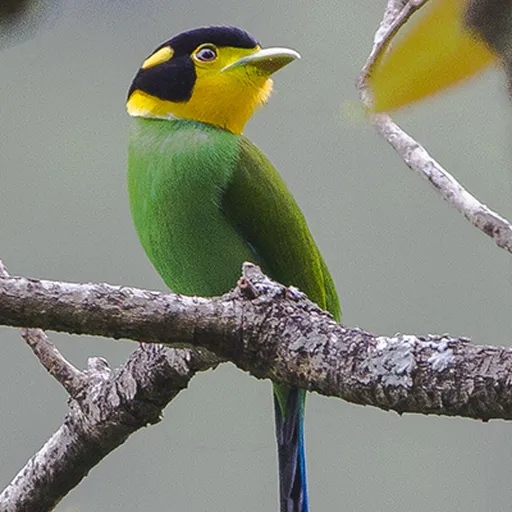
Long-tailed Broadbill
Psarisomus dalhousiae
Least Concern
Overview
The long-tailed broadbill (Psarisomus dalhousiae) is a species of songbird found in the Himalayas, extending east through Northeastern India to Southeast Asia. It is the sole member of the genus Psarisomus and belongs to the family Eurylaimidae.
Identification
- Bright yellow throat and face with a thin band around the neck, contrasting with a black cap and blue patches on the crown and nape.
- Bright green back, belly, and wings, with a long blue tail and black under-tail.
- Strong, broad bill that is yellowish green with lighter edges.
- Distinctive shrill calls consisting of loud, sharp, downward-inflected whistles such as "pseeu..pseeu" or "tseeay..tseeay".
Habitat
This bird inhabits broad-leaved evergreen forests, often near small bodies of water such as streams, across altitudes from 150 to 2,500 meters. Its range covers the Himalayas, Myanmar, and discontinuously through Southeast Asia to the Malay Peninsula, Sumatra, and Borneo. Populations in higher Himalayan altitudes may move to lower elevations during cold winters.
Diet
Insectivorous, foraging in small parties for grasshoppers, crickets, beetles, aphids, flies, moths, and spiders. They occasionally feed on small frogs, berries, and other fruits. Foraging often occurs in small flocks or mixed-species groups, particularly outside the breeding season.
Did you know?
These birds may be cooperative breeders, as observations have shown more than two individuals attending the nest. They build large, pear-shaped nests attached to tree branches, constructed from fine roots, dead leaves, and mosses.
Sources
- Wikipedia · CC BY-SA 4.0
- Wikidata · CC0 1.0