
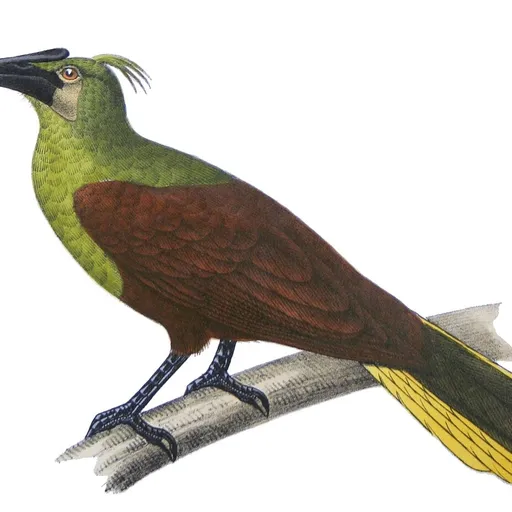
Olive Oropendola
Psarocolius bifasciatus
Least Concern
Overview
The olive oropendola, Psarocolius bifasciatus, is a spectacularly large species of bird in the Icteridae family. It is the largest member of its genus and is found throughout the Amazon and upper Orinoco river basins in South America.
Identification
- Males are 47 to 53 cm long and feature long nape feathers forming a crest, while smaller females lack this crest.
- The nominate subspecies displays a blackish-brown 'hood' on the head and upper breast contrasting with chestnut underparts, while other subspecies are predominantly yellow-olive or dark olive-green.
- The large bill is mostly black with a vermilion or reddish outer third and a swollen casque, set against a patch of bare pinkish facial skin.
- The male song has a rattling, metallic quality, often rendered as "tek-tk-k-k-k-gpp-guhloóp!" and delivered during a bowing display.
Habitat
The species primarily inhabits mature humid terra firme, várzea, gallery, and secondary forests, as well as river islands and plantations near primary habitat. Its range covers Brazil, Bolivia, Colombia, Ecuador, Peru, and Venezuela, with different subspecies occupying distinct geographic zones from the western Andes to eastern Pará.
Diet
As an omnivore, the olive oropendola feeds on insects, snails, nectar, and both wild and cultivated fruits. It forages mostly individually or in small flocks of up to five in the canopy, occasionally joining mixed-species feeding groups that include other oropendolas, caciques, and jays.
Did you know?
The species is polygynous and nests in colonies by constructing open-topped bag or purse-shaped nests woven from plant fibers. These nests are often hung from tree branches in dead trees or those that extend above the forest canopy.
Sources
- Wikipedia · CC BY-SA 4.0
- Wikidata · CC0 1.0