
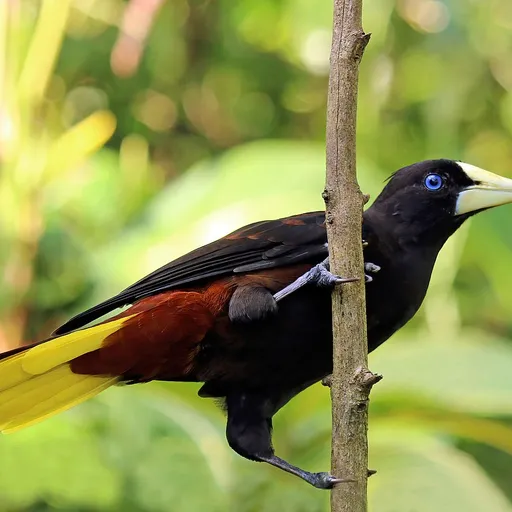
Crested Oropendola
Psarocolius decumanus
Least Concern
Listen
XC1107398 · Rosa Elena Albornoz @rosaelena_naturaleza · Colonia Vacacional, Vargas, La Guaira, Venezuela · CC0 1.0
Overview
The crested oropendola (Psarocolius decumanus), also known as the cornbird, is a member of the icterid family and undoubtedly the commonest and most widespread oropendola. It is classified as Least Concern by the IUCN, with an estimated population of at least five million mature individuals.
Identification
- Adult males are slightly glossy black with a chestnut rump, uppertail coverts, and undertail coverts, and possess long feathers on the nape forming a crest.
- Males average 47 cm (19 in) in length and weigh about 285 g, while females are smaller, duller, and brownish-tinged with a minimal crest.
- Both sexes feature a large ivory to pale yellow bill with a swollen casque, a blue iris, and black legs and feet.
- The male's display song typically begins with low-pitched liquid notes, accelerates into a complex rattling crescendo, and ends with rhythmic wing-flaps.
Habitat
This species inhabits a variety of landscapes, favouring the edges and clearings of primary forest in tropical, subtropical, and lower montane zones, as well as gallery forest, savanna, and plantations. It is not regularly found in extensive primary forest and occupies an extremely large range across South America, Central America, and Trinidad and Tobago.
Diet
The crested oropendola feeds primarily on wild and cultivated fruits, insects, and spiders, with small vertebrates such as tree-frogs and floral nectar making up smaller components of its diet. It forages mostly in flocks within the upper levels of the forest, sometimes joining mixed-species flocks containing other icterids and jays.
Did you know?
The male display song is described as very complex, including high, rapid, staccato flutes and liquid curls, often transcribed as a descending rattling gurgle ending in a quavering liquid hooting phrase. The species is also persecuted as an agricultural pest in Trinidad, Venezuela, and some other areas due to its consumption of cultivated fruits.
Sources
- Wikipedia · CC BY-SA 4.0
- Wikidata · CC0 1.0