
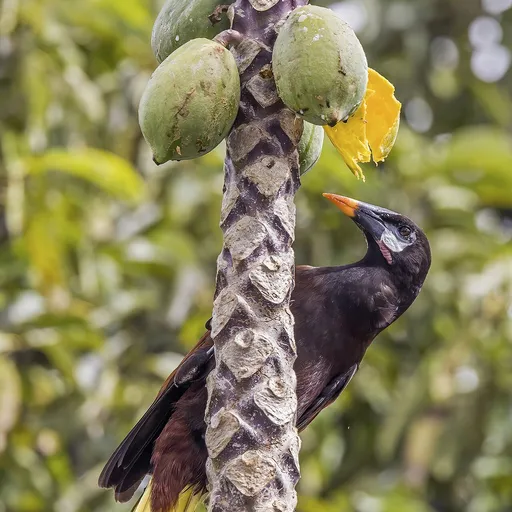
Montezuma Oropendola
Psarocolius montezuma
Least Concern
Overview
The Montezuma oropendola (Psarocolius montezuma) is a New World tropical icterid bird found in the Caribbean coastal lowlands from southeastern Mexico to central Panama. It is also present on the Pacific slope of Nicaragua and Honduras, as well as in northwestern and southwestern Costa Rica, though it is absent from El Salvador and southern Guatemala.
Identification
- Males are mainly chestnut with a blackish head and rump, and a bright yellow tail except for two dark central feathers.
- Features a bare blue cheek patch and a pink wattle; the long bill is black at the base with a red tip.
- Males are significantly larger than females, measuring 50 cm (20 in) long and weighing 520 g, whereas females are 38 cm (15 in) long and weigh 230 g.
- The male's unforgettable song consists of conversational bubbling followed by loud gurgles, described as "tic-tic-glik-glak-GLUUuuuuu".
Habitat
The species inhabits forest canopy, edges, and old plantations, where it is a colonial breeder. It is quite common in parts of its range, though it becomes mobile and makes seasonal movements outside the breeding season.
Diet
This omnivorous bird forages in trees for small vertebrates, large insects, nectar, and fruit, including bananas, Cecropia spikes, gumbo-limbo, and Trophis racemosa. Females often forage on thin branches for insects in curled leaves, while males perch on thick branches to feed in epiphytes and bromeliads.
Did you know?
The species exhibits extreme sexual dimorphism, with males being 100% larger in body mass than females, making it one of the most sexually dimorphic birds in the world. This size difference is directly related to foraging habits and is associated with male dominance in a female-defence mating system similar to that of polygynous mammals.
Sources
- Wikipedia · CC BY-SA 4.0
- Wikidata · CC0 1.0