
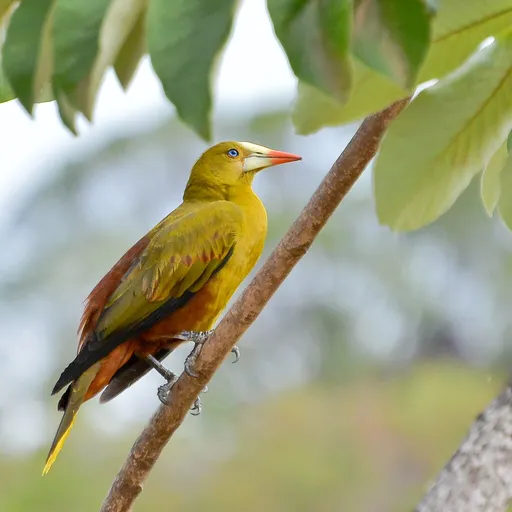
Green Oropendola
Psarocolius viridis
Least Concern
Listen
XC243015 · Niels Krabbe · Orellana: 'Maxus' road km 37 (27 km SSE Pompeya), Ecuador · CC BY-SA 4.0
Overview
The green oropendola (Psarocolius viridis) is a large, sedentary bird native to the Amazon Basin and the Guianas. It belongs to the family Icteridae and is considered the most forest-adapted of the oropendolas, showing sensitivity to habitat disturbance.
Identification
- Large size with a significant sexual dimorphism: males average 48.5 cm in length while females measure 37 cm.
- Mostly yellowish olive plumage with chestnut rump, uppertail coverts, belly, and thighs; males possess a long crested nape while females lack this feature.
- Distinctive large bill featuring a swollen casque, with the inner half appearing pea-green and the outer half orange-red.
- Vocalisations include complex songs described as a rapid, squealing, and liquid sequence ending in a gurgling ronc-ronc-ronc-ronc, alongside calls such as scratchy queea notes.
Habitat
Found across the southeastern part of Colombia, southern Venezuela, the Guianas, eastern Ecuador, northern Peru, and Amazonian Brazil, with a small disjunct population in central Peru. It primarily inhabits humid primary forests, including várzea, terra firme, gallery, and lower montane types, and is rare in disturbed areas. The species reaches elevations of up to 1,100 m in Venezuela, though typically lower in other regions.
Diet
The green oropendola feeds mostly on insects and other arthropods, with some consumption of fruit and nectar. It forages in flocks, usually within the forest canopy, and has been observed following red-throated caracaras to feed on wasp nest prey. In French Guiana, it acts as an important seed disperser.
Did you know?
The female weaves a unique nest shaped like a bag or purse with an open top from plant fibres, hanging it from a tree branch tip typically between 20 and 25 m above the ground.
Sources
- Wikipedia · CC BY-SA 4.0
- Wikidata · CC0 1.0