
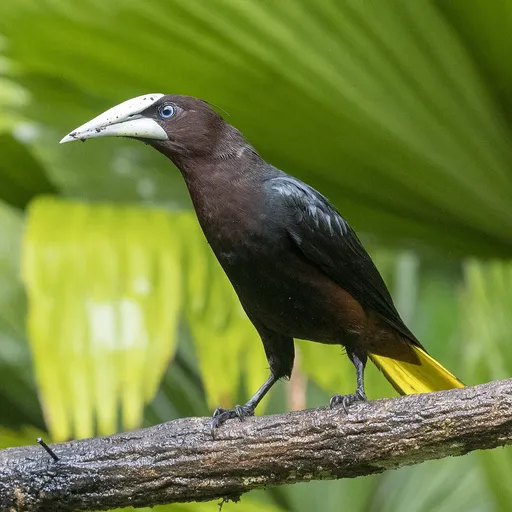
Chestnut-headed Oropendola
Psarocolius wagleri
Least Concern
Listen
XC251419 · Niels Krabbe · Esmeraldas: 11 km WSW Same, Ecuador · CC BY-SA 4.0
Overview
The chestnut-headed oropendola (Psarocolius wagleri) is a species of bird in the family Icteridae, found in tropical and subtropical regions of Mexico, Central America, and northwestern South America. It is currently classified as a species of Least Concern by the IUCN Red List, although its population is believed to be decreasing.
Identification
- Males average 35 cm in length with a slight crest, a dark purplish chestnut head and upper breast, and a black body with a bluish gloss.
- Females are slightly smaller at 28 cm and possess similar markings but in duller colours.
- Both sexes feature a very large, ivory-coloured bill with a swollen casque that often has a pale greenish tinge.
- The species has a pale blue iris, black legs, and yellow tail feathers edged in black, while its song is described as loud, gurgling, and preceded by harsh slashing notes.
Habitat
The species inhabits evergreen and secondary forests in tropical and lower subtropical zones, as well as plantations and suburban areas. Its range extends from southeastern Mexico through Central America into Colombia and Ecuador, typically between sea level and 1,700 m in elevation.
Diet
The chestnut-headed oropendola feeds primarily on small vertebrates such as frogs and lizards, supplemented by insects, other arthropods, fruit, and nectar. It usually forages from the mid-story to the canopy of the forest, typically in flocks of up to 15 individuals.
Did you know?
The species exhibits polygyny and nests in colonies that can contain up to 130 nests in a single tree or group of trees, with females weaving elaborate bag or purse-shaped structures from plant fibres like palm leaves and vines.
Sources
- Wikipedia · CC BY-SA 4.0
- Wikidata · CC0 1.0