
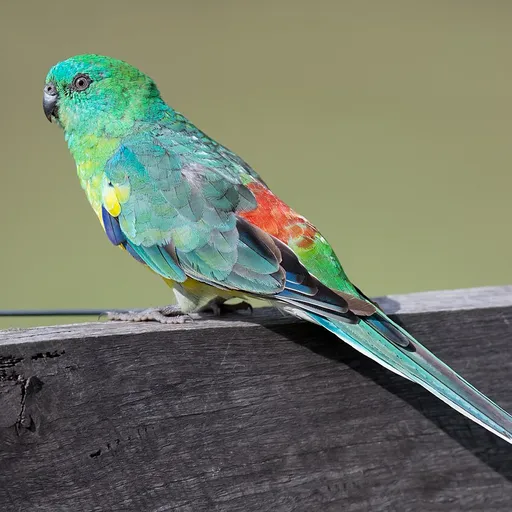
Red-rumped Parrot
Psephotus haematonotus
Least Concern
Overview
The red-rumped parrot, also known as the red-backed parrot or grass parrot, is a medium-sized broad-tailed parrot endemic to open woodland in south-eastern Australia. It is a highly sexually dimorphic species, with the male displaying bright green and gold plumage and the female appearing in duller olive-green tones. The species is widely distributed and currently listed as Least Concern on the IUCN Red List.
Identification
- Adult males possess bright emerald-green plumage with yellow underparts, dull green-blue mantles, and a distinctive brick-red rump, whereas adult females are a duller olive-green with lime-green rumps.
- The species is slim and measures approximately 28 cm in length, weighing between 45 and 77 grams.
- Adult males have darker grey bills, while immature birds have brown to yellow-brown bills; blue outer wing tips are visible in flight for both sexes.
- Calls consist of an attractive 'chee chillip chee chillip' sound.
Habitat
Found in south-eastern Australia below 1,000 metres, the range encompasses most of New South Wales and Victoria, as well as parts of southern Queensland and eastern South Australia. The bird inhabits lightly timbered plains, open woodland, and grassy habitats, avoiding coastal and heavily wooded areas. It has adapted well to human-modified environments, commonly occurring in paddocks, fields, parks, gardens, and roadside verges.
Diet
The diet primarily consists of seeds and leaves of grasses and other herbaceous plants, both native and introduced, with occasional feeding on small fruits, shoots, and flowers. They predominantly forage on the ground in pairs or small flocks, sometimes associating with other seed-eating parrots such as galahs and eastern rosellas.
Did you know?
Unlike many other Australian birds that decline due to land clearing, the distribution and population of the red-rumped parrot are likely increasing as ongoing deforestation creates more of the open habitat it prefers. In captivity, these birds can be bred for over 22 colour mutations, and with proper care, they may live up to 32 years.
Sources
- Wikipedia · CC BY-SA 4.0
- Wikidata · CC0 1.0