
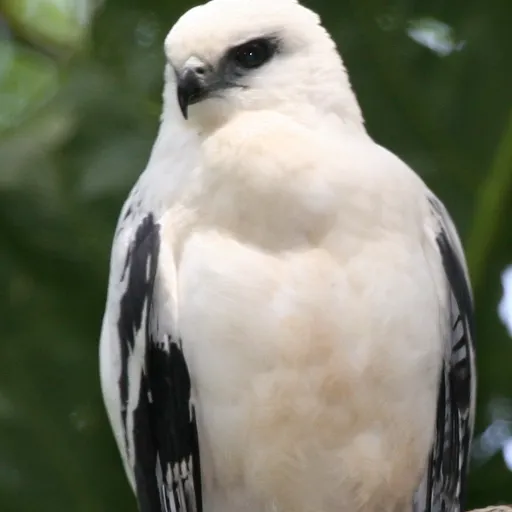
White Hawk
Pseudastur albicollis
Least Concern
Overview
The white hawk (Pseudastur albicollis) is a bird of prey in the family Accipitridae that breeds across the tropical New World. Though widely distributed from Mexico to South America, it is usually not common, yet it is not considered globally threatened due to the extensive reach of its range.
Identification
- Adult birds are 46–56 cm long with very broad wings, featuring a white head, body and underwings contrasted by black upper wings and a short tail with a broad white band.
- The bill is black and the legs are yellow, while the call is a plaintive 'kerwee'.
- Females are larger and heavier than males, and immature birds display extensive black spotting on the upperparts and dark-streaked whitish underparts.
Habitat
This species inhabits lowland forests and other woodlands, ranging from southern Mexico through Central and South America to Peru, Bolivia and Brazil, as well as Trinidad. Its range in central South America encompasses the entire Amazon basin, stretching from the Andes to the Guianas and extending south into transition lands.
Diet
The white hawk feeds primarily on reptiles such as lizards and snakes, along with insects, crabs, amphibians and mammals, which it catches in a sortie from a perch. It may also prey on birds, including keel-billed toucans and mottled owls, and occasionally feeds on fish, evidenced by remains found in stomachs in Suriname. The bird associates with foraging groups of tufted capuchin monkeys and South American coatis to snatch prey startled by these animals.
Did you know?
The white hawk performs a spectacular aerial courtship display. It also builds a large stick platform nest in a tree, usually laying a single dark-blotched blue-white egg.
Sources
- Wikipedia · CC BY-SA 4.0
- Wikidata · CC0 1.0