
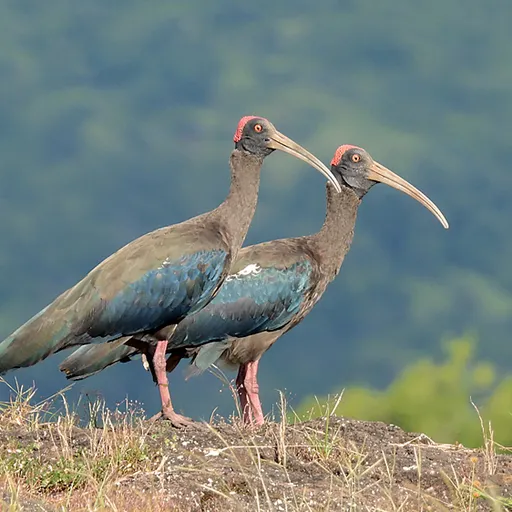
Red-naped Ibis
Pseudibis papillosa
Least Concern
Overview
The red-naped ibis (Pseudibis papillosa), also known as the Indian black ibis, is a large, mostly dark bird found across the plains and agricultural areas of the Indian subcontinent. Unlike many other ibises, it is rarely seen in waterbodies and is often found foraging in dry fields, though it is attracted to landscapes with more wetlands. It is currently classified as a species of Least Concern.
Identification
- A large black bird with a long, downcurved bill and long legs; wing feathers and tail have a blue-green gloss while the neck and body are brown.
- A white patch on the shoulders stands out against the dark plumage.
- The head is bare with a triangular patch of bright red warty skin on the crown and nape; the iris is orange-red.
- Bills and legs are grey but turn reddish during the breeding season.
Habitat
This species is widely distributed in the plains of the Indian subcontinent, including the Indian states of Haryana, Punjab, Rajasthan and the Gangetic plains, as well as lowland Nepal. It uses diverse environments such as lakes, marshes, riverbeds, irrigated farmlands, dry fallow fields, villages and cities, avoiding forested regions and the arid zone of the extreme southeast of the peninsula. The bird is largely diurnal and roosts communally on trees or islands at night.
Diet
The red-naped ibis is omnivorous, feeding on crustaceans, insects, scorpions, frogs, small vertebrates, grain, and carrion. It forages mainly in dry open land and stubbly fields, probing the soft ground for earthworms, disturbed insects, and beetle grubs, and is frequently observed at garbage dumps. In small towns, it may hunt adult Rock Pigeons and predate their eggs, and in British India it was called a 'planter's friend' for consuming large numbers of crickets on indigo plantations.
Did you know?
An increasing number of pairs are building nests on cell phone towers and electricity pylon towers, a habit that was not observed in studies from the 1990s and appears to have been recently learnt.
Sources
- Wikipedia · CC BY-SA 4.0
- Wikidata · CC0 1.0