
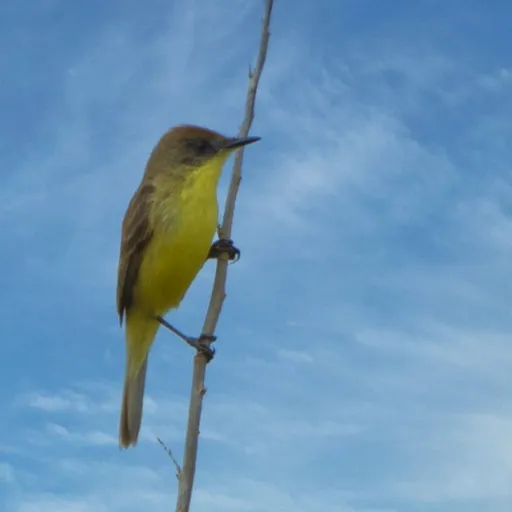
Ticking Doradito
Pseudocolopteryx citreola
Least Concern
Listen
XC653379 · Capovilla Pablo H · Laguna Paiva, La Capital, Santa Fe, Argentina · CC BY-SA 4.0
Overview
The ticking doradito (Pseudocolopteryx citreola) is a small tyrant flycatcher found in parts of South America. It is currently classified as a separate species from the warbling doradito following taxonomic revisions in 2010.
Identification
- Approximately 12.5 cm long with a dull olive-brown head and upperparts, featuring a rufescent crown and dusky lores and cheeks.
- Throat and underparts are lemon yellow, contrasting with the dark olive-brown tail.
- Wings are dull olive-brown with cinnamon edges on the flight feathers, forming two thin wing bars.
- Song consists of low clicking sounds that start slowly and increase in rapidity, resembling pebbles striking together, ending abruptly with phrases like 'tick, tick, tick, tick-tick-tick-you'.
Habitat
This species inhabits dense Baccharis shrubs, open brushlands with Tamarix shrubs and trees, and freshwater reed beds. In Chile, it also occupies marshes and willow thickets along watercourses. Its range covers Argentina, Bolivia, Chile, and possibly Paraguay, with altitudes ranging from sea level in Chile to 1,300 m in Argentina.
Diet
The diet is primarily insectivorous, mirroring that of the warbling doradito. Foraging occurs singly or in small family groups, typically low and deep within the vegetation, involving gleaning while perched and occasional short hovering flights.
Did you know?
The species was only separated from the warbling doradito in 2010, with the distinction based primarily on vocal differences rather than visible plumage traits.
Sources
- Wikipedia · CC BY-SA 4.0
- Wikidata · CC0 1.0