
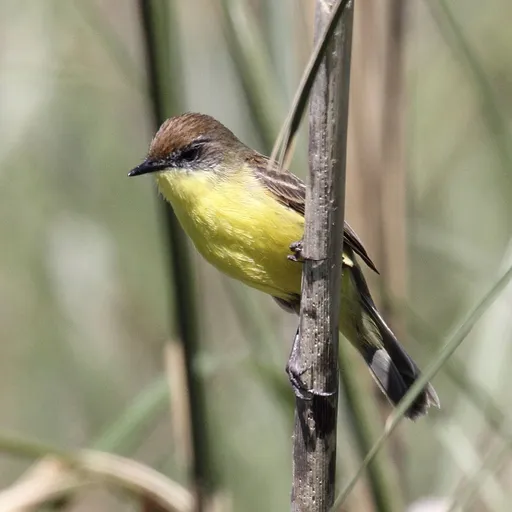
Warbling Doradito
Pseudocolopteryx flaviventris
Least Concern
Overview
The warbling doradito (Pseudocolopteryx flaviventris) is a species of tyrant flycatcher found across parts of South America. It is a small, monotypic bird that was previously confused with the ticking doradito until vocal differences led to their separation in 2010.
Identification
- Adults measure 11 to 12 cm in length and feature dull olive-brown upperparts with a rufescent crown and dusky lores and cheeks.
- Throat and underparts are bright yellow, with two faint wing bars visible on dull olive-brown wings.
- Males have a slender, black, warbler-like bill, while females possess a mostly black bill with a pale pinkish base to the mandible.
- Song consists of a mechanical introduction of staccato notes followed by a set of 4–8 more musical notes, such as 'chek, chek, chek, chek-chick-chick-chiquetik'.
Habitat
This species inhabits reedbeds, freshwater and sawgrass marshes, and riparian vegetation, ranging from sea level up to 500 m in elevation. It is distributed across Argentina, Paraguay, Uruguay, and southern Brazil, moving into somewhat drier grassy areas during the non-breeding season.
Diet
The diet is primarily insectivorous, though specific details are not fully documented. The bird forages singly or in small family groups, typically low and deep in the vegetation, taking prey by gleaning while perched or occasionally through short flights to hover-glean.
Did you know?
Although now recognised as a distinct species, the ticking doradito was previously classified within the warbling doradito without even being acknowledged as a separate subspecies, a confusion that persisted until 2010 when vocal differences prompted their separation.
Sources
- Wikipedia · CC BY-SA 4.0
- Wikidata · CC0 1.0