
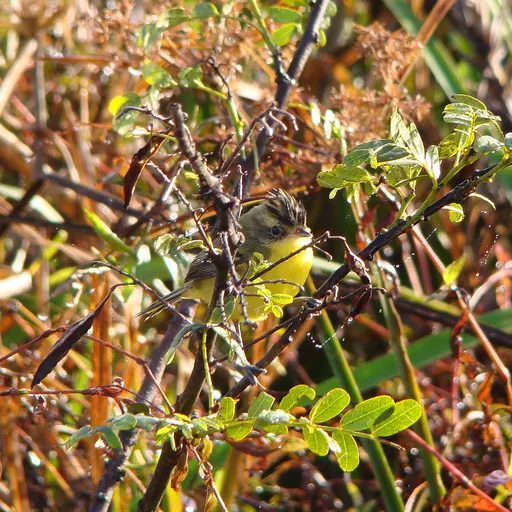
Crested Doradito
Pseudocolopteryx sclateri
Least Concern
Overview
The crested doradito (Pseudocolopteryx sclateri) is a species of tyrant flycatcher found across parts of South America, including Argentina, Bolivia, Brazil, Guyana, Paraguay, Uruguay, and Venezuela. It is classified as a species of Least Concern by the IUCN, with a large range and a stable population that is apparently very local but sometimes quite common.
Identification
- Measures 10 to 11 cm in length and weighs between 6 and 9.9 g, featuring a shaggy crest in both sexes.
- Adult males display a pale olive body with a blackish crown edged in yellowish white, dusky cheeks, and bright yellow underparts, while females have paler heads and underparts with faint pale yellow supercilia.
- Both sexes possess dark brown irises and black legs with a long hallux; males have slender, all-black bills, whereas females have a black upper mandible and a pinkish-orange lower mandible.
- Vocalisations in the southern range include a very high, liquid 'wic-wic-wic-' song and a mellow 'wik wik' call, while on Trinidad the song is described as a squeaky 'tsik-tsik-tsee-lee' and the call as a high, thin, soft 'sik'.
Habitat
The species inhabits reed beds, marshes, and tall grassy areas near water, reaching elevations of 500 m in general, though only 200 m in Venezuela. Its distribution is highly disjunct, with its largest range extending from eastern Bolivia through southwestern Brazil and Paraguay into northeastern Argentina and Uruguay, with isolated populations in other regions.
Diet
Although its diet is not fully detailed, the crested doradito is known to consume insects and spiders. It forages in pairs or small family groups, typically gleaning vegetation while perched in marshes or along their borders, often clinging sideways to sedge or reed stems to feed.
Did you know?
Nests are constructed as cups from grasses, sedge stems, and thin rootlets, sometimes uniquely incorporating spider egg cases and insect cocoons as lining or on the outside. These nests are attached to reed or sedge stems directly over water.
Sources
- Wikipedia · CC BY-SA 4.0
- Wikidata · CC0 1.0