
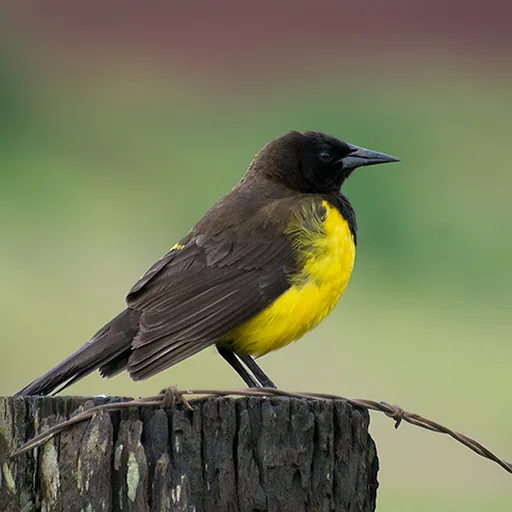
Yellow-rumped Marshbird
Pseudoleistes guirahuro
Least Concern
Overview
The yellow-rumped marshbird (Pseudoleistes guirahuro) is a species of bird in the family Icteridae, found in southern South America. It is a year-round resident classified as Least Concern on the IUCN Red List, with a stable population across its large range.
Identification
- Males average 25.5 cm in length and weigh approximately 91.2 g, while females average 81.9 g; sexes share identical plumage.
- Adults feature a blackish brown head, neck, and upper breast, with brown upperparts, a rich yellow rump, and brown wings displaying rich yellow median and lesser coverts as an epaulet.
- The lower breast and belly are rich yellow, while undertail coverts are brown with thin yellow edges; both sexes possess a brown iris, blackish bill, and blackish legs.
- The song is a mix of whistles, warbles, slurs, and nasal buzzes that is slower and less screechy than that of the similar brown-and-yellow marshbird.
Habitat
This species inhabits marshes, wet grasslands, nearby drier uplands, rice fields, and wet savannas with sparse trees, notably being one of the few icterids found in cerrado habitats. Its range extends from southern Brazil south through eastern Paraguay and northern Uruguay into northeastern Argentina, reaching altitudes up to 1,100 m in Brazil.
Diet
It feeds on insects, other arthropods, smaller numbers of small vertebrates, and some seeds, foraging both on the ground and in low vegetation. During the non-breeding season, it forages in flocks that can number up to 50 individuals and may include other icterids, with some members acting as sentinels.
Did you know?
The yellow-rumped marshbird is a cooperative breeder that can recruit up to six helpers to a nest, where the female builds the structure and incubates the eggs while being fed by the male. Fledgling success is aided by both parents and these helpers, though the shiny cowbird is a common brood parasite.
Sources
- Wikipedia · CC BY-SA 4.0
- Wikidata · CC0 1.0