
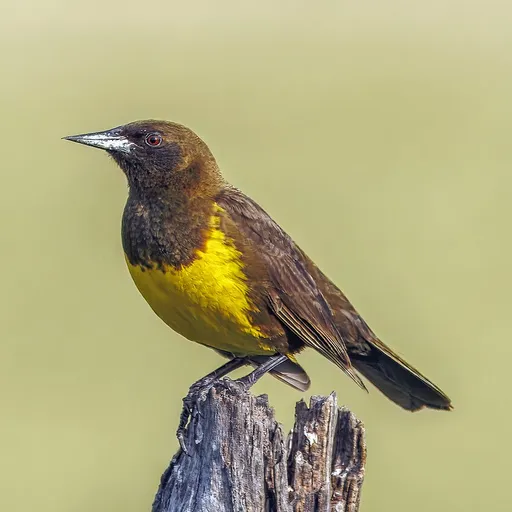
Brown-and-yellow Marshbird
Pseudoleistes virescens
Least Concern
Overview
The brown-and-yellow marshbird, scientifically known as Pseudoleistes virescens, is a species of bird in the family Icteridae. It is found across far southern Brazil, most of Uruguay, and parts of Argentina, with occasional vagrant records in Paraguay.
Identification
- Adults are mostly deep brown to olive brown, with rich yellow on the lower breast and belly, and yellow upperwing coverts visible primarily in flight.
- The species averages 24 cm in length, with males weighing approximately 79.6 g and females 72.9 g.
- Both sexes possess a brown iris, a blackish bill, and blackish legs and feet, while juveniles exhibit a yellowish throat and striped breast.
- The song consists of screechy chattering notes mixed with whistles, accompanied by a loud repeated 'chrrr-wéé' call and a loud wooden rattle as an alarm call.
Habitat
This bird inhabits marshes, wet grasslands, pastures, and cultivated fields, primarily at low altitudes though it has been seen up to 2,100 m in Argentina during the non-breeding season. It roosts in tall emergent marsh vegetation and tall grass on land.
Diet
The brown-and-yellow marshbird feeds mostly on insects and arthropods such as spiders, with occasional consumption of small vertebrates and seeds. It forages on the ground by probing soil and turning over objects like cow dung, often in flocks that may include other icterids and include sentinel individuals.
Did you know?
As a cooperative breeder, the species can have up to six helpers assisting at a nest, with both parents and helpers provisioning the nestlings after fledging.
Sources
- Wikipedia · CC BY-SA 4.0
- Wikidata · CC0 1.0