
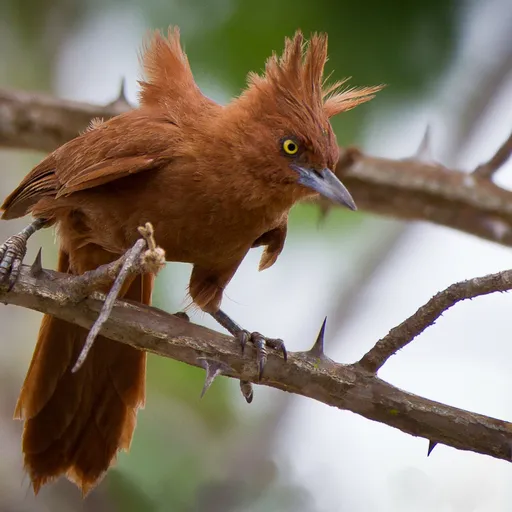
Caatinga Cacholote
Pseudoseisura cristata
Least Concern
Overview
The Caatinga cacholote (Pseudoseisura cristata) is a large, crested bird in the ovenbird family Furnariidae, endemic to Brazil. It is classified as Least Concern by the IUCN, with a population believed to be increasing despite an unknown total size.
Identification
- Adults are 25 to 26 cm long, predominantly bright reddish-rufous, slightly paler on the underparts, with fuscous tips on flight feathers.
- Yellow eyes in adults, contrasting with the bluish grey iris of juveniles, which also display dusky facial and underpart streaking and a shorter crest.
- Possesses a long bill and tail feathers lacking barbs at the ends.
- Vocalises through duets; one bird produces loud, piercing 'tjew' notes, while the other replies with buzzy 'zjeep' notes.
Habitat
Found in eastern Brazil, ranging from 50 to 500 m in elevation, the species inhabits the woodlands and scrub of the Caatinga biome as well as tropical deciduous forest. It is common around dwellings away from dense human populations and frequently extends its range into areas where forest has been cleared or is severely degraded.
Diet
Feeds on a mixed diet of arthropods and plant material. Foraging is typically conducted in pairs on the ground, where the birds probe and dig to locate their prey.
Did you know?
The bird constructs elongated nests from thorny sticks that can incorporate anthropogenic materials such as razor blades, forks, plastic fragments, paper, and barbed wire. Breeding groups may include up to four adults, all of whom help provision nestlings, though the relationships between these helpers remain unknown.
Sources
- Wikipedia · CC BY-SA 4.0
- Wikidata · CC0 1.0