
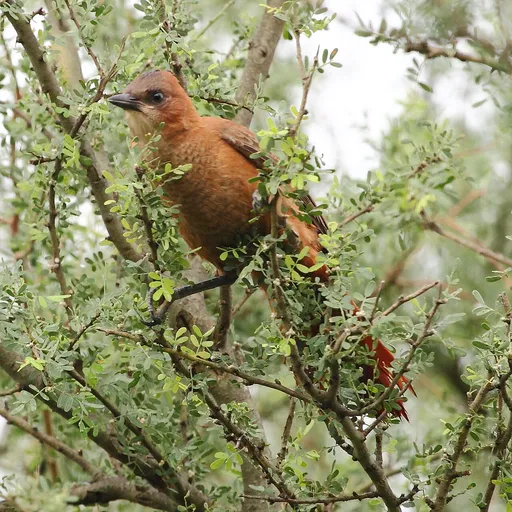
Brown Cacholote
Pseudoseisura lophotes
Least Concern
Overview
The brown cacholote (Pseudoseisura lophotes) is a medium-sized, omnivorous bird belonging to the ovenbird family Furnariidae. It is classified as a species of Least Concern and is found in the humid regions of South America, from Bolivia to Uruguay.
Identification
- Length ranges from 24 to 26 cm with a weight of 63 to 79 g, making it one of the largest furnariids.
- Entirely rufous plumage with a notably dark crest resembling that of a jay, along with dark primary and secondary flight feathers.
- Features a black bill, yellow iris, and grayish-olive to dull greenish legs.
- Distinguished by a loud 'krok' or 'cluck' call and duetting songs composed of coarse, variably noisy notes that fade towards the end.
Habitat
The species inhabits tropical deciduous forests, gallery forest edges, chaco woodlands, and urban parks or gardens within the Gran Chaco and Argentine Espinal regions. It resides at elevations from near sea level up to 900 m and is a nonmigratory year-round resident throughout its range in Argentina, Bolivia, Brazil, Paraguay, and Uruguay.
Diet
Omnivorous with one of the largest diets of any ovenbird, consuming arthropods such as beetles and ants, as well as eggs from other birds, tree sap, seeds, snails, small amphibians, and fruit. It forages primarily on the ground by gleaning, probing, and digging in soil and leaf litter, often in pairs or groups.
Did you know?
Unlike many other birds, the brown cacholote constructs large, pitcher-like nests that weigh two to five kilograms, many times more than the bird itself. These massive structures are built year-round, with old nests frequently destroyed or repurposed as materials for new constructions.
Sources
- Wikipedia · CC BY-SA 4.0
- Wikidata · CC0 1.0