
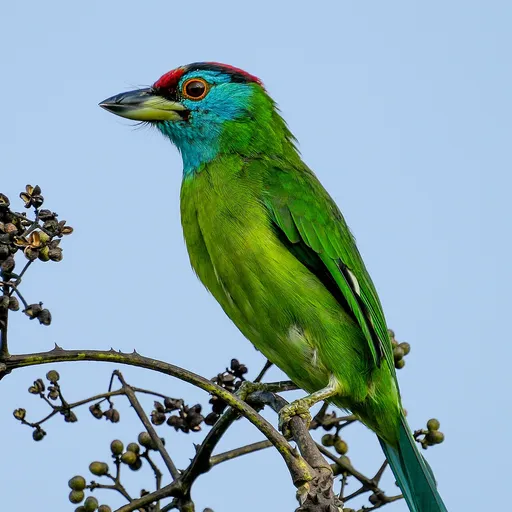
Blue-throated Barbet
Psilopogon asiaticus
Least Concern
Overview
The blue-throated barbet (Psilopogon asiaticus) is a green Asian barbet native to the foothills of the Himalayas and Southeast Asia. It is a non-migratory, arboreal species found in lowland and montane forests, classified as Least Concern on the IUCN Red List.
Identification
- Plumage: Stocky, green body with lighter yellow-green undersides and a short tail that may have a bluish cast.
- Head Markings: Distinctive head and neck featuring a bright red forehead, black stripe across the crown, red rear crown, and pale blue sides of the face, chin and upper neck.
- Bill and Feet: Stout, conical bill that is pale at the base with a dark upper mandible and tip; feet are slate-gray to gray-green.
- Vocalisation: Emits loud, frequent calls such as 'took-a-rook' or 'pu-ku-ruk' repeated 90–105 times per minute, which often reveals its presence better than its cryptic green colouring.
Habitat
It inhabits lowland and montane forests at elevations of 200–2,000 m, ranging from the Lower Himalayas in northeastern Pakistan and India through the hill ranges of Southeast Asia. The species is adaptable to secondary forests and urban areas provided fruiting trees are available.
Diet
Feeds primarily on fruits and berries, especially figs of Ficus species, often seen in the upper canopy of fruiting trees. It also consumes insect larvae, crickets, mantids and large centipedes while perched, and occasionally catches flying termites in the air.
Did you know?
Both parents share domestic duties, including nest building, incubation and raising the young, with courting displays involving pairs feeding and vocalising together. The species frequently reuses nests over several years and may even take over old nests from woodpeckers.
Sources
- Wikipedia · CC BY-SA 4.0
- Wikidata · CC0 1.0