
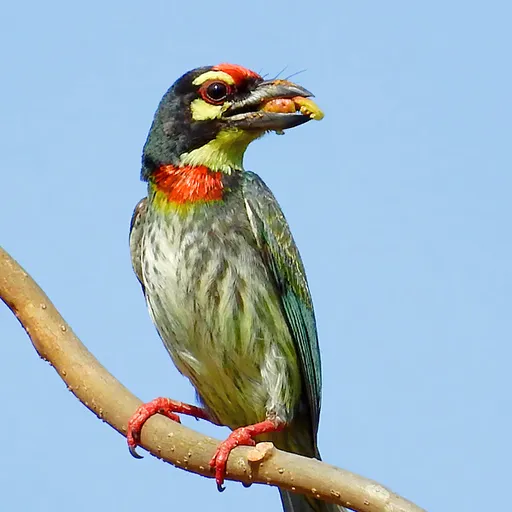
Coppersmith Barbet
Psilopogon haemacephalus
Least Concern
Listen
XC879002 · Jairam Vijayan · Payyavoor, Kannur, Kerala, India · CC BY-SA 4.0
Overview
The coppersmith barbet (Psilopogon haemacephalus), also known as the crimson-breasted barbet, is a small Asian barbet recognised for its loud, metronomic call. It is a resident species found throughout the Indian subcontinent and parts of Southeast Asia, where it inhabits a variety of wooded environments.
Identification
- Green plumage with a distinctive red head and yellow cheeks and throat.
- Underparts are streaked in grey and black, while the upper back may appear bluish during the nesting season due to wear and tear.
- Measures 15–17 cm in length and weighs between 30 and 52.6 g.
- Produces a loud, metallic tuk or tunk sound that resembles a copper sheet being beaten, delivered in a steady, monotonous rhythm.
Habitat
Found in gardens, groves, and sparse woodland, the species relies on habitats with dead wood suitable for excavating nest holes. It ranges across the Indian subcontinent and Southeast Asia, with altitudinal limits varying from 1,200 m in the Palni Hills to 910 m in the northern Indian Himalayan valleys.
Diet
Predominantly frugivorous, it prefers banyan, peepul, and other wild figs, along with various drupes, berries, and flower petals. It occasionally feeds on insects, such as winged termites, caught in aerial sallies, consuming up to nearly three times its own body weight in berries each day.
Did you know?
The bird's call is produced with the beak shut; instead, a patch of bare skin on both sides of the throat inflates and collapses like a rubber bulb with each tuk, accompanied by head-bobbing. This unique vocal mechanism is the source of its name, as the sound mimics a coppersmith striking metal with a hammer.
Sources
- Wikipedia · CC BY-SA 4.0
- Wikidata · CC0 1.0