
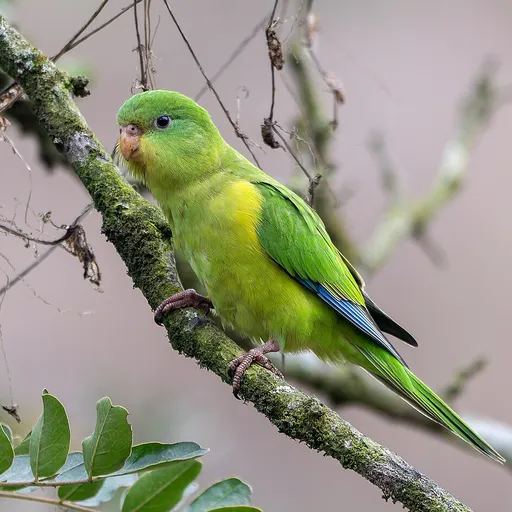
Mountain Parakeet
Psilopsiagon aurifrons
Least Concern
Overview
The mountain parakeet, also known as the golden-fronted parakeet, is a small species of parrot within the family Psittacidae. It is classified as Least Concern on the IUCN Red List and is found across the Andean region.
Identification
- Reaches about 18 cm (7 in) in length and weighs approximately 45 g (1.6 oz).
- The nominate male features a green head, mantle, back, and tail with blue outer webs on the primary feathers, while the face, throat, and breast are yellow, fading to a yellowish-green belly.
- Females resemble males but possess a yellow forehead, and juveniles are similar to females but have shorter tails.
- The bill is typically horn-coloured in the nominate subspecies, though it is grey or pinkish-buff in other subspecies.
Habitat
This species inhabits subtropical or tropical high-altitude shrubland and Puna grassland at elevations between 1,000 and 4,500 metres. It occupies the Andes in Peru, Chile, Bolivia, and Argentina, preferring vegetation near rivers, bushy slopes, scrub, and agricultural land, as well as man-made environments like parks. The bird is non-migratory but moves to higher altitudes in summer and lower ones in winter.
Diet
A sociable bird, the mountain parakeet forages on the ground and in scrub for the buds, berries, and seeds of plants such as Fabiana densa, Lepidophyllum, and Adesmia.
Did you know?
Breeding occurs at different times of the year depending on the location within its range. Clutches of three to six eggs are laid in holes or crevices in rocky outcrops, cliff faces, or river banks.
Sources
- Wikipedia · CC BY-SA 4.0
- Wikidata · CC0 1.0