
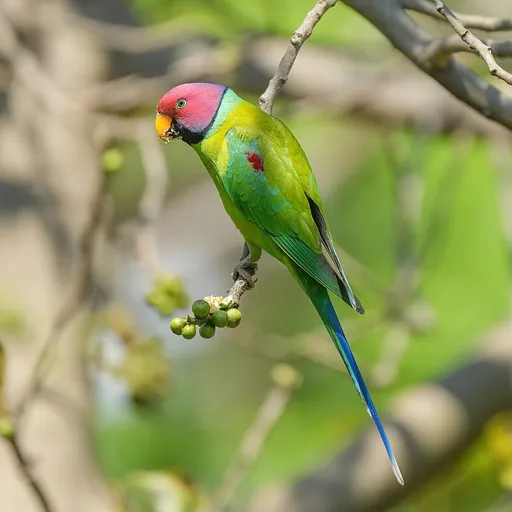
Plum-headed Parakeet
Psittacula cyanocephala
Least Concern
Overview
The plum-headed parakeet is a mainly green parrot species in the family Psittacidae, which is endemic to the Indian subcontinent. It was historically considered conspecific with the blossom-headed parakeet but is now recognised as a distinct species with a population ranging from the Himalayas to Sri Lanka.
Identification
- 33–37 cm long with a tail up to 22 cm, weighing 55–85 g.
- Males have a red head shading to purple-blue, while females possess a blueish-grey head.
- Males feature a black neck collar and chin stripe; females lack these and instead have a yellow collar.
- Both sexes have a white-tipped tail, with males showing an orangish-yellow upper mandible and a dark lower mandible, whereas females have a corn-yellow upper mandible.
Habitat
This bird inhabits forests and open woodlands, extending its presence to city gardens. Its range stretches from the foothills of the Himalayas south to Sri Lanka, though it is notably absent from the dry regions of western India.
Diet
The plum-headed parakeet feeds on grains, fruits, and the fleshy petals of flowers such as Salmalia and Butea, occasionally raiding agricultural fields and orchards for food. Its movements are driven primarily by the seasonal availability of these food sources.
Did you know?
The species' delicate bluish-red appearance, which resembles the bloom of a peach, is an optical effect created by the rami of the feathers combined with red pigment in the barbules. A 5th-century BC Greek physician named Ctesias described the bird's talking abilities in his lost work Indica, potentially making it one of the earliest recorded parrots in Western literature.
Sources
- Wikipedia · CC BY-SA 4.0
- Wikidata · CC0 1.0