
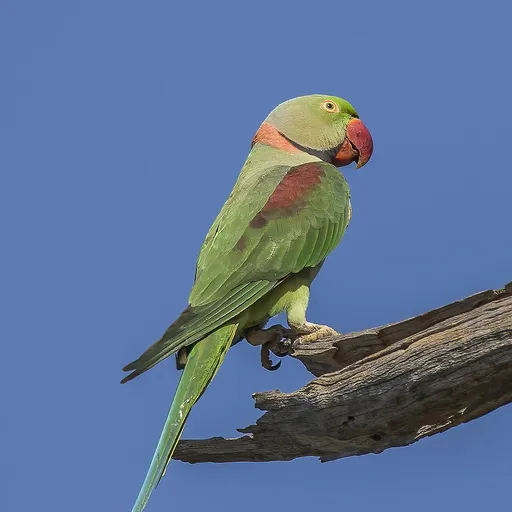
Alexandrine Parakeet
Psittacula eupatria
Listen
XC779125 · Sudipto Roy · Kankrajhore, India · CC BY-SA 4.0
Overview
The Alexandrine parakeet, also known as the Alexandrine parrot, is a medium-sized parrot native to South and Southeast Asia. It was named after Alexander the Great, who is thought to have transported numerous birds from Punjab to Europe and the Mediterranean, where they were prized by royalty and nobility.
Identification
- Predominantly green plumage with a light blue-grey sheen on the cheeks and nape, a yellow-green abdomen, and a red patch on the shoulders.
- Possesses a massive red beak with yellow tips and a long tail that transitions from green to blue on the upper side and is yellow underneath.
- Adult males feature a black stripe across the lower cheeks and a pink band on the nape, whereas adult females lack both markings.
- Produces a variety of calls including a ringing trrrieuw, loud kree-aar, and deep klak-klak sounds that are deeper and harsher than those of the rose-ringed parakeet.
Habitat
This species inhabits forests, woodlands, agricultural lands, and mangrove forests at elevations up to 900 m. It is native to South and Southeast Asia but has established feral populations in parts of the Middle East, Europe, and Pakistan.
Diet
The bird feeds on a variety of wild and cultivated seeds, buds, fruits, and nuts. Although it usually lives in small flocks, it forms larger groups where food is abundant or at communal roosts, and flocks can cause extensive damage to ripening fruits and grain crops such as maize and jowar.
Did you know?
In captivity, these birds can live up to 40 years and are known for their playful behaviour and ability to imitate human speech. The World Parrot Trust recommends that they be kept in a metal or welded mesh enclosure with a minimum length of 4.5 metres.