
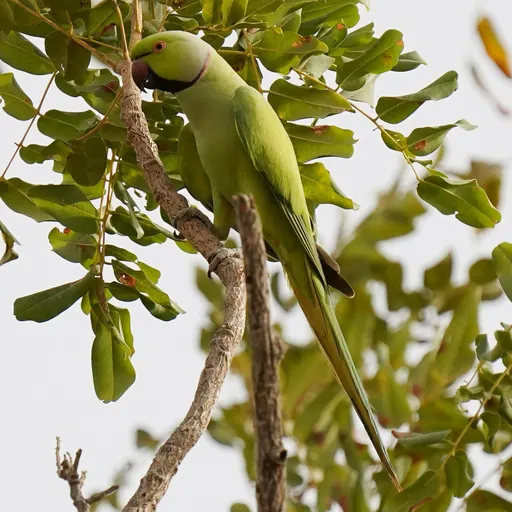
Rose-ringed Parakeet
Psittacula krameri
Least Concern
Listen
XC952626 · Philippe_Grange · Arrondissement de la Roche-sur-Yon (near La Roche-sur-Yon), Vendée, Pays de la Loire, France · CC0 1.0
Overview
The rose-ringed parakeet, also known as the ring-necked parakeet or Indian Ringneck, is a medium-sized parrot of the family Psittaculidae. Native to tropical northern Africa and the Indian subcontinent, it has successfully established feral populations in many other parts of the world following escapes from the exotic pet trade.
Identification
- 37–43 cm in length, with a large portion of the total length comprising the tail feathers.
- Distinctive green plumage with a red beak and blue tail in the wild.
- Sexually dimorphic; adult males possess a pink and black neck ring, whereas females and immature birds show no ring or a shadow-like grey ring.
- Noisy species with an unmistakable squawking call.
Habitat
Native range covers a narrow belt across northern Africa and the Indian subcontinent, but the species has colonised many other countries, including large parts of Europe, where it now breeds further north than any other parrot species. It is one of the few parrot species that have successfully adapted to living in disturbed habitats, withstanding urbanisation and deforestation, and can survive low winter temperatures in northern Europe.
Diet
In the wild, they feed on buds, nectar, fruit, vegetables, nuts, berries, seeds, grains, and insects, with flocks often flying to farmlands and orchards to forage. Feral populations regularly visit gardens and human habitations to take food from bird feeders.
Did you know?
In Seville and the Rhineland, rose-ringed parakeets have been documented attacking the greater noctule bat at tree cavities, leading to sharp declines in bat populations as the parakeets occupy and defend these nesting sites, often killing the adult bats to secure them.
Sources
- Wikipedia · CC BY-SA 4.0
- Wikidata · CC0 1.0