
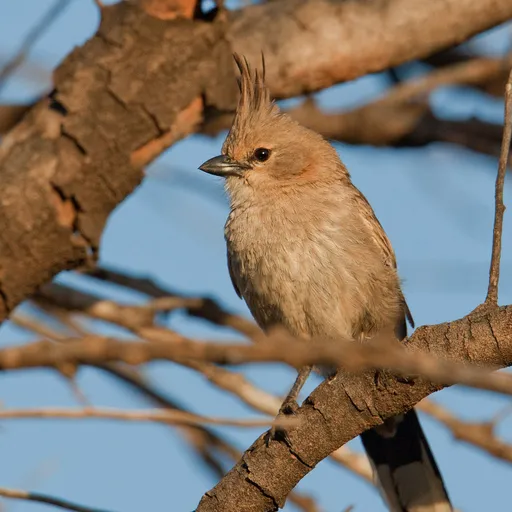
Chirruping Wedgebill
Psophodes cristatus
Least Concern
Overview
The chirruping wedgebill (Psophodes cristatus) is a medium-sized songbird endemic to Australia and a member of the genus Psophodes. It is distinguished from the similar chiming wedgebill by its distinctive call, with the two species being recognised as separate entities since 1973.
Identification
- Medium-sized bird measuring 18–21 cm in length.
- Pale brown upperparts and white or pale grey underparts, with flight feathers edged in white and a dark black-brown tail featuring a white tip.
- Dark, wedge-shaped bill in mature birds, which is horn-coloured in immatures; possesses a slim upright crest and a slightly longer tail compared to the chiming wedgebill.
- Faint breast streaking helps distinguish it from the chiming wedgebill.
- Call is a repetitive, sparrow-like chirruping duet, described as 'sitzi-cheeri' by the male and an upward rolling 'r-e-e-e-t CHEER' by the female.
Habitat
Found throughout south-eastern inland Australia in low, open shrublands containing acacia, bluebush, emu bush, and lignum species. Its distribution is patchy but locally abundant where present, and it is rarely found in the southern part of its range.
Diet
The species feeds predominantly on seeds and insects, foraging by making short flights or running between cover in its shrubland habitat.
Did you know?
Although adults are generally sedentary, juvenile birds can form large, loose foraging flocks of up to 100 individuals that wander over greater distances.
Sources
- Wikipedia · CC BY-SA 4.0
- Wikidata · CC0 1.0