
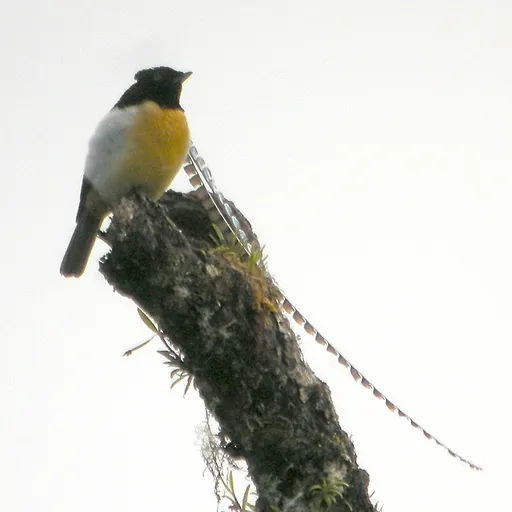
King of Saxony Bird-of-paradise
Pteridophora alberti
Least Concern
Overview
The King of Saxony bird-of-paradise is the sole species in the genus Pteridophora and a member of the bird-of-paradise family. This species is endemic to the montane forests of New Guinea, where it remains fairly common despite local hunting pressures. It is currently classified as Least Concern on the IUCN Red List.
Identification
- Adult males are black and yellow with a dark brown iris, brownish-grey legs, and a black bill featuring a bright aqua-green gape.
- They possess two remarkably long (up to 50 cm) scalloped, enamel-blue brow-plumes that can be independently erected.
- Females are unadorned, appearing greyish brown with barred underparts.
- Males produce songs reminiscent of radio-static hisses, lasting four to five seconds and repeated at one-minute intervals to attract females.
Habitat
The species inhabits montane forests across New Guinea, ranging from the Weyland Mountains in Western New Guinea to the Kratke Range and Mount Giluwe in Papua New Guinea. Its distribution is primarily between 1,300–2,850 meters above mean sea level, though it is usually found between 1,800–2,500 meters.
Diet
The diet of the King of Saxony bird-of-paradise consists mainly of fruits, berries, and arthropods. Specific details regarding its foraging techniques are not provided in the reference material.
Did you know?
The ornamental head plumes of the male are so bizarre that, when the first specimen was brought to Europe, it was initially thought to be a fake. These unique feathers, which can be twice the length of the bird's body, have no functional structure and were evolved through female selection for indirect genetic benefits.
Sources
- Wikipedia · CC BY-SA 4.0
- Wikidata · CC0 1.0