
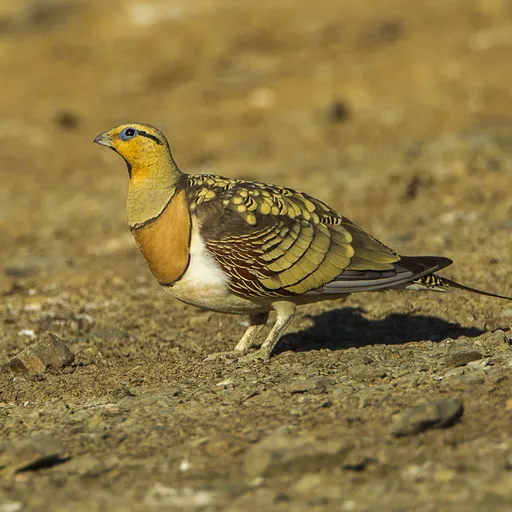
Pin-tailed Sandgrouse
Pterocles alchata
Least Concern
Overview
The Pterocles alchata, or pin-tailed sandgrouse, is a medium-sized bird in the sandgrouse family characterised by a small, pigeon-like head and a sturdy, compact body. It is classified as Least Concern on the IUCN Red List, with a population estimated between 130,000 and 1,500,000 individuals. As a gregarious species, it is often found in flocks that gather at watering holes at dawn.
Identification
- Size: approximately 31 to 39 cm in length, with a small head, neck and long pointed wings.
- Plumage: general colouring is cryptic with barred and flecked olive green, brown, buff, yellow, grey and black; underparts are dull white.
- Markings: males in breeding plumage have yellowish-green upperparts, a black throat patch, and a broad reddish-brown breast band bordered by black; tail features long central streamers.
- Song: loud kattar-kattar call, a nasal ga-ga-ga, and a low-pitched gang gang when in flight.
Habitat
Breeds in open areas of stony land, semi-arid regions at the edge of deserts, treeless plains and occasionally dried-out mud flats, with a distribution spanning North Africa, the Middle East, Turkey, Iran, Iraq, Kazakhstan, and parts of southern Europe. In winter, eastern populations migrate to Pakistan and northern India, occasionally visiting ploughed or fallow land. The species does not occur at elevations above approximately 1,000 metres.
Diet
Feeds primarily on seeds, with a preference for leguminous species, and also consumes buds, green shoots, leaves, beetles and other small invertebrates. Forages during the day, often in groups, and consumes grit to help grind the contents of the crop. In cultivated areas, they take grain and the seeds of leguminous crops.
Did you know?
Males transport water to their chicks by absorbing it into the feathers on their breast, with the young learning to feed themselves by the age of one week. The species name alchata is believed to be derived from the Arabic name al-gata, which is itself derived from the bird's call.
Sources
- Wikipedia · CC BY-SA 4.0
- Wikidata · CC0 1.0