
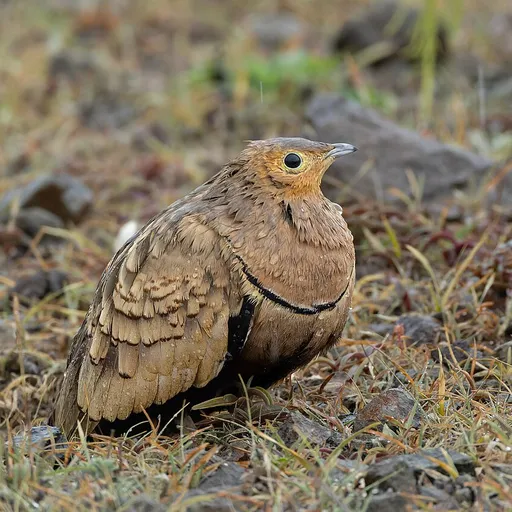
Chestnut-bellied Sandgrouse
Pterocles exustus
Least Concern
Overview
The chestnut-bellied sandgrouse, or common sandgrouse (Pterocles exustus), is a sedentary and nomadic species found across northern and central Africa and western and southern Asia. Despite its name suggesting a relation to grouse, it is more closely related to pigeons and doves. The species is classified as Least Concern on the IUCN Red List.
Identification
- Small to medium-sized, brownish birds with an elongated, pointed tail when in flight.
- Very short-legged with a small head, often stretching a long neck when wary.
- Sexually dimorphic; males possess distinctive vinous-buff upper breasts separated by a narrow black band bordered in white, while females feature dull-buff plumage streaked with dark brown.
- Six subspecies exist that vary in plumage, ranging from darker greyer tones in the Nile Valley to paler, greyer variants in other regions.
Habitat
The species inhabits bare, bushy, arid, and sandy plains, as well as barren semi-deserts. Its wide range spans the Afrotropic and Indomalayan biogeographic realms, including specific desert environments such as the Thar and Sindh Deserts in India.
Diet
These selective feeders primarily subsist on small seeds, often consumed in large quantities, with a preference for seeds from leguminous plants. They also feed on small insects and fallen berries. They require regular daily water, often travelling up to 80 kilometres to find it and congregating at single waterholes in their thousands during dry summers.
Did you know?
During courtship, females are pursued by several males at once, but only one male will follow her after a short period. In the Thar and Sindh Deserts, hatchlings are precocious and leave the nest shortly after hatching.
Sources
- Wikipedia · CC BY-SA 4.0
- Wikidata · CC0 1.0