
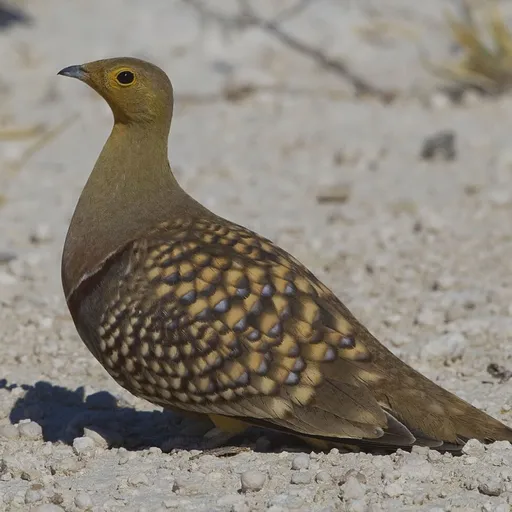
Namaqua Sandgrouse
Pterocles namaqua
Least Concern
Overview
The Namaqua sandgrouse (Pterocles namaqua) is a medium-sized, ground-dwelling bird within the sandgrouse family. It is native to arid regions of south-western Africa and is currently classified as Least Concern by the IUCN Red List.
Identification
- Medium-sized bird measuring approximately 28 cm in length, with a plump body, small head, and short legs.
- Males feature an orangish buff head, throat, and chest separated by a narrow band of white and dark brown, with two long black filaments on the olive-brown tail.
- Females and juveniles display cryptic plumage in various shades of brown patterned with white specks.
Habitat
Found in arid parts of South Africa, Namibia, Zimbabwe, Botswana, and Angola, including the Kalahari and Namib Deserts. The species favours deserts and other dry areas with rough vegetation and tussock-type grasses.
Diet
The principal diet consists of seeds, though the birds also consume leaves, flowers, small fruit, insects, and molluscs. They forage by exploring loose soil with their beaks and flicking it away sideways.
Did you know?
During the breeding season, the male carries water to the chicks in a specialized layer of feathers on his breast. The female incubates by day while the male takes a longer shift at night, beginning two hours before sunset and finishing two hours after dawn.
Sources
- Wikipedia · CC BY-SA 4.0
- Wikidata · CC0 1.0