
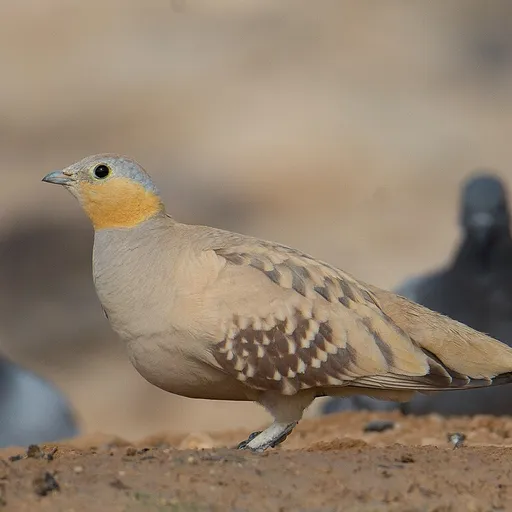
Spotted Sandgrouse
Pterocles senegallus
Least Concern
Overview
The spotted sandgrouse (Pterocles senegallus) is a small, gregarious, ground-dwelling bird in the family Pteroclidae found in arid regions of northern and eastern Africa, the Middle East, and parts of Asia. It is a diurnal species that flies once daily to a waterhole for hydration and is currently listed as a species of 'least concern' by the IUCN.
Identification
- Approximately 33 cm in length with a rapid wing beat and swift flight.
- Males possess a reddish-brown nape surrounded by a pale grey collar, an orange chin, neck, and throat, and a grey breast; upper parts are pinkish-grey with dark flight feathers and dark patches on the wings, tail, and lower belly.
- Females are generally duller with greyish-brown plumage liberally spotted with small dark markings, though they also retain the orange throat region.
- Distinguished by pale primaries with dark trailing edges, a dark belly stripe visible in flight, and a musical 'queeto-queeto' call.
Habitat
Inhabits deserts and semi-arid countryside across North Africa, the Middle East, and extending east to northwest India. It is largely resident over its extensive range but exhibits local movement, with flocks migrating to new feeding grounds after storms stimulate green growth.
Diet
Feeds primarily on seeds and other plant material found among scrubby vegetation on the ground. In the Sahara, the birds show a particular fondness for a species of spurge, concentrating on it until the foliage pears, after which they return to their normal diet of seeds.
Did you know?
The male has specially adapted, absorbent down on his belly which he saturates with water at a waterhole to feed his chicks; he emits a repeated high-pitched 'queet-queet' call to guide his family to him, after which the chicks stand beneath his raised wings to suck fluid from between the feathers.
Sources
- Wikipedia · CC BY-SA 4.0
- Wikidata · CC0 1.0