
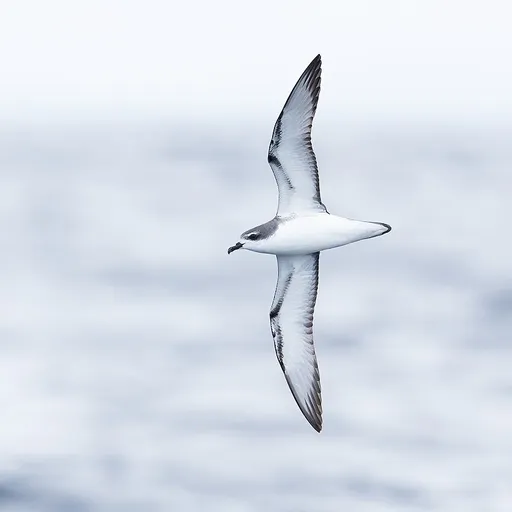
Cook's Petrel
Pterodroma cookii
Vulnerable
Overview
Cook's petrel (Pterodroma cookii), also known as tītī or blue-footed petrel, is a Procellariiform seabird endemic to New Zealand. It belongs to the gadfly petrels and is currently classified as Vulnerable by the IUCN Red List.
Identification
- Typically 25–30 cm in length with a wingspan of 65–66 cm and a weight of around 200 g.
- Pale grey upperparts featuring a dark grey 'M' on the wings and white underparts.
- Long black bill with tubular nostrils on both sides.
- Call consists of a three-part 'kek, kek, kek'.
Habitat
Breeds exclusively on three small New Zealand islands: Little Barrier Island, Great Barrier Island, and Codfish Island, nesting in burrows and rock crevices on thickly forested ridges during the southern summer. When not breeding, the species migrates to the Pacific Ocean and has occasionally been observed off the west coasts of the United States and tropical South America.
Diet
Feeds primarily on fish and squid, with some crustaceans, and is highly pelagic except during the nesting season.
Did you know?
Fossils indicate that prior to human arrival, the species bred on the North and South Islands of mainland New Zealand, but its population on Great Barrier Island has plummeted from an estimated 20,000 to just 100 due to introduced predators such as pigs, dogs, rats, and cats, as well as native weka.
Sources
- Wikipedia · CC BY-SA 4.0
- Wikidata · CC0 1.0