
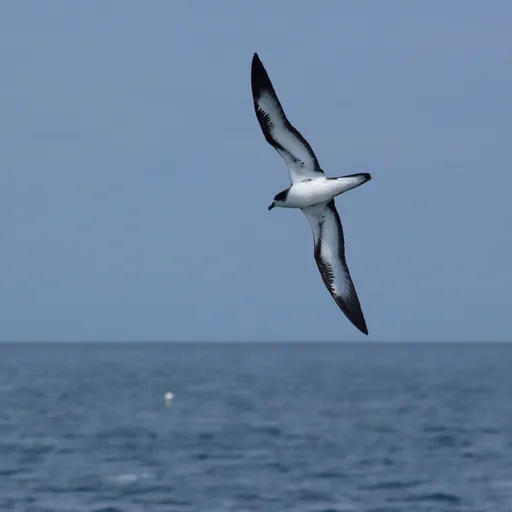
Galapagos Petrel
Pterodroma phaeopygia
Critically Endangered
Overview
The Galápagos petrel (Pterodroma phaeopygia) is one of six endemic seabirds of the Galápagos and a member of the gadfly petrel group. It is a highly pelagic species that spends most of its life at sea, returning to the islands solely for breeding. The species is currently classified as Critically Endangered due to significant population declines from introduced predators and habitat loss.
Identification
- Plumage: Dark-grey upperparts that darken towards the wingtips and tail, with white underparts and face. A distinct black hood extends to the sides of the neck, and many individuals have black freckles on the white forehead. A narrow white line is often present on each side of the rump, and the underwings feature black margins and a diagonal bar.
- Bill: Short, stout, and hooked with sharp edges, used for seizing and manipulating prey; Galápagos petrels have slightly longer and narrower bills than their Hawaiian counterparts.
- Feet: Pink legs and feet with black webbing.
- Vocalisation: Silent at sea but vocal at night near colonies, emitting shrill cries described as 'kee-kee-kee-(c)ooo' with the last note drawn out. Male calls are sweet and pleasant, while female calls are coarser and grating.
Habitat
Endemic to the Galápagos Islands, this species is highly pelagic and maladapted to terrestrial life, typically found far from land at sea. During the breeding season, it returns to large colonies on the highlands of Santiago, Floreana, Isabela, Santa Cruz, and San Cristóbal, often nesting in burrows within thick vegetation or volcanic crevices. Between January and February, individuals may disperse northeast towards South America and southwards up to 2,000 km.
Diet
The species feeds primarily on mesopelagic prey such as squids, small fish, crustaceans, and other invertebrates, which are often caught while flying just above the water surface. Foraging occurs mainly at night when prey migrate to the surface, with 82% of prey by number being bioluminescent to aid detection. During the nesting season, parents feed chicks by regurgitating semi-digested seafood mixed with high-caloric stomach oils.
Did you know?
Galápagos petrels possess external tubular nostrils that allow them to smell, detect, and locate food in the dark, a capability they also use to find their nest burrows within colonies. They are known locally as 'pata pegada' or 'web-footed one', a reference to their distinctive black webbing.
Sources
- Wikipedia · CC BY-SA 4.0
- Wikidata · CC0 1.0