
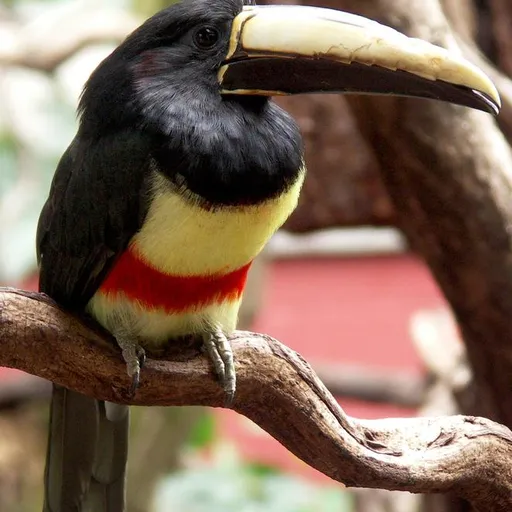
Black-necked Aracari
Pteroglossus aracari
Least Concern
Overview
The black-necked aracari is a near-passerine bird in the toucan family Ramphastidae. It is found across parts of South America, including Brazil, French Guiana, Guyana, Suriname, and Venezuela. The species is currently classified as Least Concern by the IUCN, though its population is believed to be decreasing.
Identification
- Adults of the nominate subspecies possess a black head, neck, and throat with chestnut-black ear coverts, while their upperparts are mostly green with a red rump.
- The underparts are yellow, marked by a wide red band across the lower breast and greenish thighs.
- The bill features an ivory maxilla with a black culmen and base, a black mandible, and a distinctive vertical white line at the base.
- It measures 43 to 46 cm in length, with females having shorter bills than males.
Habitat
The species inhabits a wide variety of semi-open landscapes, including edges and clearings in wet and sand-ridge forests, secondary forest, woodlands, cerrado, and gallery forest in savannas. It is found at elevations mostly ranging from sea level to about 600 m, although it occurs higher in Venezuela and the southeastern part of its range.
Diet
The black-necked aracari forages in the upper levels of the forest canopy, often in groups of up to six. It mostly feeds on fruit, acting as an important disperser of fruit tree seeds, but also consumes insects and has been observed taking nestling birds.
Did you know?
The genus name Pteroglossus combines the Ancient Greek words for 'feather' and 'tongue', while the specific epithet aracari derives from Arassari, the species' name in the Tupi language. The species was formally described by Carl Linnaeus in 1758, based on earlier illustrations by Georg Marcgrave and George Edwards.
Sources
- Wikipedia · CC BY-SA 4.0
- Wikidata · CC0 1.0