
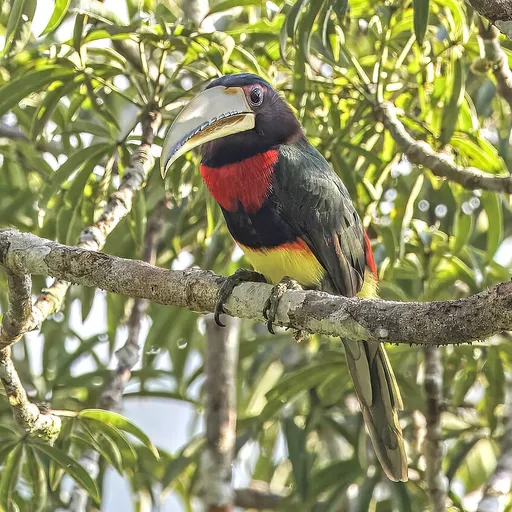
Ivory-billed Aracari
Pteroglossus azara
Least Concern
Overview
The ivory-billed aracari, Pteroglossus azara, is a toucan species classified as Least Concern by the IUCN. It is a resident bird found across parts of South America, with a large and stable range.
Identification
- Size and mass: 36 to 45 cm long and weighing between 120 and 160 g.
- Plumage: Males possess a black cap over a chestnut head and throat, a maroon-red nape, green lower back, and a red rump; they have a narrow black throat band, a wide red upper breast band, a wide black lower breast band, a yellow belly, and green thighs. Females differ by having a dark brown cap and a narrower black band under the throat.
- Bill: The nominate subspecies has a mostly yellow bill featuring a deep red to brown line on the maxilla that tapers to a black tip, with red, black, and ivory markings resembling teeth. The flavirostris subspecies has a yellow to ivory maxilla with an orange spot under the nostril, black and white 'teeth', and a yellow to ivory mandible with a narrow orange-brown line.
- Song: Described as a series of 2–6 wailing 'twaaa-a-a', 'tweee-ee', or 'traaa-at' notes, along with various rattles, grunt-like contact notes, and nasal 'nyek' sounds.
Habitat
This species inhabits a variety of forest landscapes including varzea, gallery, and secondary forests, with a preference for early- to mid-successional growth over mature forest. It also uses terra firme, bamboo, cloudforest, and plantations to a lesser extent, typically below 600 m but regularly found up to 900 m. Its range includes Brazil, Colombia, Ecuador, Peru, and Venezuela, and it is a year-round resident throughout this area.
Diet
Foraging occurs in the forest's upper levels and canopy, usually in pairs or small groups. While detailed dietary information is limited, the bird appears to feed primarily on fruit alongside some arthropods.
Did you know?
The species' scientific epithet, azara, honours the Spanish soldier and naturalist Félix de Azara, following a 1807 description by François Levaillant that was formally published by Louis Vieillot in 1819.
Sources
- Wikipedia · CC BY-SA 4.0
- Wikidata · CC0 1.0