
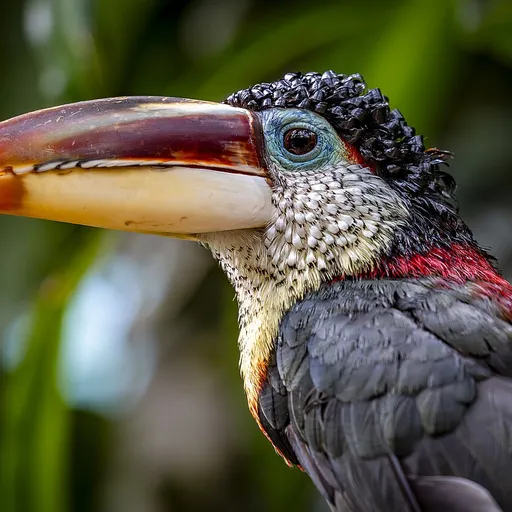
Curl-crested Aracari
Pteroglossus beauharnaisii
Least Concern
Overview
The curl-crested aracari (Pteroglossus beauharnaisii) is a near-passerine bird in the toucan family Ramphastidae. It is currently assessed as being of Least Concern on the IUCN Red List, though its population is believed to be decreasing. This species is found in the southwestern Amazon Basin across parts of Bolivia, Brazil, and Peru.
Identification
- Distinctive curly, shiny black feathers on the head and nape that resemble pieces of plastic or enamel.
- Large bill with a brown-orange line at the base; the mandible is ivory transitioning to orange at the tip, while the maxilla features a green or bluish area with a maroon stripe.
- Plumage consists of a red upper back and rump, dark green upperparts, and yellow underparts marked by a wide red band across the lower breast.
- Calls include deep 'rrek' notes, hard grunting 'grenk' notes, and a raucous 'cha-cha-cha cha wruh cha--'.
Habitat
This species inhabits the interior, clearings, and edges of wet forests, including both well-drained and swampy areas. Its range covers the southwestern Amazon Basin south of the Amazon River, extending from northern Peru south of the Marañón River into western Brazil and northern and central Bolivia. It primarily occurs at elevations below 500 m but can be found as high as 900 m near the Andes.
Diet
The curl-crested aracari usually forages in groups of up to 12 individuals, typically within the canopy but also feeding at fruiting bushes near the ground. Its diet consists mainly of fruit but also includes the eggs and young of other birds. It is known to tear apart the nests of yellow-rumped caciques (Cacicus cela) to obtain these eggs and chicks.
Did you know?
The bird's name is derived from its unique curly, shiny black head feathers, which are described as resembling pieces of plastic or enamel. Additionally, this toucan actively raids the nests of yellow-rumped caciques to steal their eggs and young.
Sources
- Wikipedia · CC BY-SA 4.0
- Wikidata · CC0 1.0