
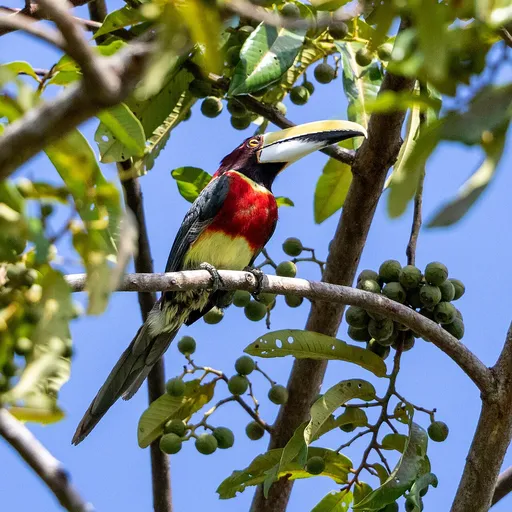
Red-necked Aracari
Pteroglossus bitorquatus
Near Threatened
Overview
The red-necked aracari (Pteroglossus bitorquatus) is a bird in the toucan family Ramphastidae found in Bolivia and Brazil. It is currently classified as Near Threatened by the IUCN due to ongoing deforestation in the Amazon basin, with population sizes believed to be decreasing.
Identification
- Length of 36 to 40 cm with a weight of 112 to 171 g.
- Bill features a yellow to greenish white maxilla with black and white edges resembling teeth, and a mandible with a white base angling under the black.
- Males display a blackish crown, dark brown face, red nape and breast separated by yellow and black bands, dark green upperparts, and yellow underparts; females are browner with a narrower yellow band.
- Vocalisations include repeated "tik" or "tek" notes, "ttak" or "tyat" sounds, and growl-like, chattery "dcheeeaah" calls.
Habitat
Found in Bolivia and Brazil, inhabiting a variety of forest types from sea level to 800 m, including moist tropical terra firme, gallery forest in cerrado, dense bamboo, and mature secondary forest. It ranges across Brazil south of the Amazon River, with subspecies distribution extending from the Rio Madeira and Tapajós river systems east to the Atlantic coast in Maranhão and south to Rondônia and eastern Bolivia.
Diet
The species forages from the forest mid-level to the canopy, either alone, in pairs, or in small groups. While its diet is not well known, it is primarily composed of fruit and likely includes insects, eggs, and small vertebrates.
Did you know?
Adult males are easily distinguished by the yellow and black bands that separate their red nape and breast from the throat, whereas immatures appear duller and orange where adults are red. The subspecies P. b. sturmii is treated as a separate species by BirdLife International, known as the western red-necked araçari.
Sources
- Wikipedia · CC BY-SA 4.0
- Wikidata · CC0 1.0