
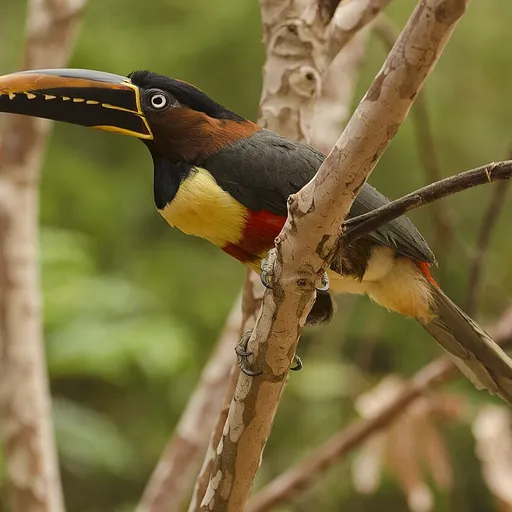
Chestnut-eared Aracari
Pteroglossus castanotis
Least Concern
Overview
The chestnut-eared aracari (Pteroglossus castanotis) is a near-passerine bird in the toucan family Ramphastidae. It is a wide-ranging species found across much of South America, classified as Least Concern by the IUCN despite a believed decreasing population size.
Identification
- Size: 43 to 47 cm long, weighing 220 to 310 g.
- Bill: Features black and ivory markings on the edge that resemble teeth, with a yellow line at the base in nominate adults.
- Plumage: Males have a black crown, chestnut lower nape, dark green back, and red rump; females are browner on the head.
- Vocalisation: Principal calls include a piercing 'sneeep' or a longer 'psheee-eeep'.
Habitat
Inhabits the western and southern Amazon Basin across Argentina, Bolivia, Brazil, Colombia, Ecuador, Paraguay, and Peru. It occupies a wide variety of landscapes, including wet forests, várzea, swamp and gallery forests, bamboo groves, and coffee plantations. Typically found below 600 m, though it reaches up to 1,300 m in some Andean locations.
Diet
Primarily frugivorous, foraging at all forest levels by plucking fruit from branches and probing vines, shrubs, and cavities. It also consumes flowers and nectar, as well as bird eggs and nestlings. During the austral winter, it moves into fruit-rich areas such as plantations.
Did you know?
This species occasionally forages by hanging upside down to pluck fruit from branches. It also exhibits evidence of cooperative breeding, with small groups often tending to a nest rather than just pairs.
Sources
- Wikipedia · CC BY-SA 4.0
- Wikidata · CC0 1.0