
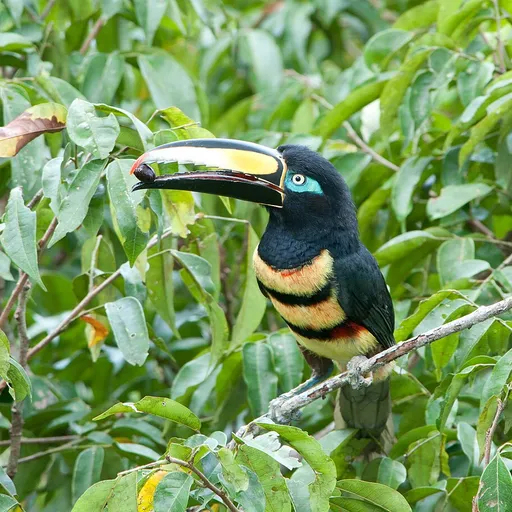
Many-banded Aracari
Pteroglossus pluricinctus
Least Concern
Listen
XC251441 · Niels Krabbe · Napo: Napo Galeras, Ecuador · CC BY-SA 4.0
Overview
The many-banded aracari, or many-banded araçari (Pteroglossus pluricinctus), is a near-passerine bird in the toucan family Ramphastidae. It is a year-round resident found across parts of South America, including Brazil, Colombia, Ecuador, Peru, and Venezuela. The species is currently assessed as Least Concern by the IUCN, though its population is believed to be decreasing.
Identification
- Length of 43 to 46 cm (17 to 18 in) including a large bill of 11 to 12.5 cm (4.3 to 4.9 in), weighing between 215 and 302 g.
- Adult males feature a mostly black head, throat, and neck with bare blue-green to green skin around the eye and a chestnut patch behind it.
- Underparts are yellow with two distinct bands: an upper black band and a lower black and red band.
- The bill has an orange-yellow line at its base, an orange-yellow maxilla with a wide black stripe on the culmen and a black base, and a black mandible; females have a shorter bill and little to no chestnut behind the eye.
- Calls are variously described as "seeent", "seeet", "see-yeet", "kyseek", and "kyeek".
Habitat
The species ranges from northeastern Colombia and parts of Venezuela south through eastern Ecuador to northeastern Peru and east into northwestern Brazil north of the Amazon River and east to Roraima state. It primarily inhabits terra firme forest, with lesser presence in várzea and gallery forests, mostly up to 750 m elevation but occasionally as high as 1,000 m.
Diet
Foraging occurs singly, in pairs, or in small groups, with a diet that is primarily frugivorous but also includes insects, small birds, bird eggs, and lizards. The bird plays a role in seed dispersal, likely regurgitating seeds rather than excreting them, with a dispersion range of hundreds of meters.
Did you know?
The many-banded aracari likely regurgitates seeds rather than excreting them, contributing to seed dispersal over a range of hundreds of meters.
Sources
- Wikipedia · CC BY-SA 4.0
- Wikidata · CC0 1.0