
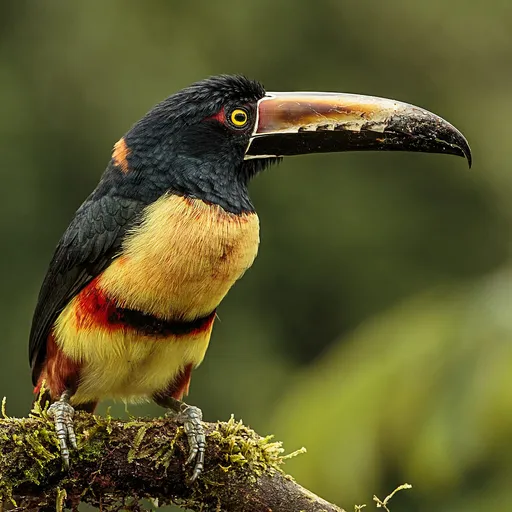
Collared Aracari
Pteroglossus torquatus
Least Concern
Overview
The collared aracari is a near-passerine bird in the toucan family that ranges from Mexico to Colombia and Venezuela. It is classified as a species of Least Concern on the IUCN Red List despite a believed decreasing population.
Identification
- Adults measure 38 to 41 cm in length and feature a large bill with a narrow vertical white line at the base and a dull reddish brown maxilla.
- Plumage consists of glossy black upperparts, a cinnamon rufous collar at the nape, and a bright red lower back, contrasting with greenish black heads and yellow underparts.
- Males and females share identical coloration, though females possess a shorter bill than males.
- The most common call is a high, sharp, squeaky note described as "seek," "pseek," or "pink."
Habitat
The species inhabits the interior and edges of evergreen primary forest and mature secondary forest, as well as coffee, cacao, and fruit plantations. It is found at elevations ranging from sea level to approximately 1,000 m, extending from east-central Mexico through Central America to northwestern Colombia and northern Venezuela.
Diet
The collared aracari primarily consumes fruit but also feeds on large insects, the eggs and nestlings of other birds, and other small vertebrates. It forages from the forest's mid-level to the canopy, gleaning fruit by stretching, bending, or hanging upside down, and regurgitates large viable seeds.
Did you know?
Collared aracaris are known to roost communally, with up to seven individuals occupying a single tree cavity overnight. They also provision nestlings alongside parents, with up to three other adults assisting in feeding the young.
Sources
- Wikipedia · CC BY-SA 4.0
- Wikidata · CC0 1.0