
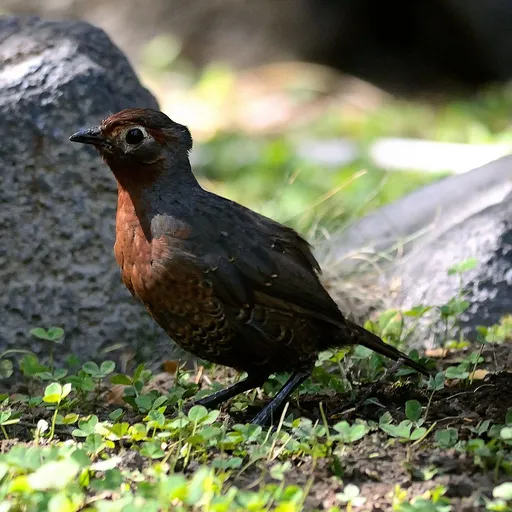
Chestnut-throated Huet-huet
Pteroptochos castaneus
Least Concern
Overview
The chestnut-throated huet-huet (Pteroptochos castaneus) is a large passerine bird belonging to the family Rhinocryptidae, recognised as the third-heaviest tracheophone suboscine. It inhabits the humid fringe of the Mediterranean climate zone in southern Chile and a small area of Argentina, where it is currently classified as Least Concern on the IUCN Red List.
Identification
- A stockily-built bird averaging 23 centimetres in length with predominantly dark brown plumage.
- Distinguished by a dark red throat and a pale buff bar on its wings, a feature absent in the related black-throated species.
- Produces a song consisting of resonant 'hoots' typically given as a duet between pairs, which is higher, softer, and faster than that of the black-throated huet-huet.
- Issues a 'wehk, wehk, wehk' call when alarmed.
Habitat
This species is found in temperate forests of Nothofagus species and Austrocedrus chilensis on the humid fringe of the Mediterranean climate zone, chiefly in the Biobío, Maule, and parts of the O'Higgins Regions in Chile, along with a small adjacent area in Neuquén Province, Argentina. It may also occur in exotic Pinus radiata plantations, provided there is a dense understory of shrubs to facilitate movement.
Diet
The chestnut-throated huet-huet feeds on insects and their larvae, as well as a substantial number of seeds and fruit. It forages by digging through the forest floor with its long claws, potentially playing an important role in the dispersal of certain forest plants.
Did you know?
Although breeding occurs in spring between September and December, the birds dig their nesting burrows during the winter rainy season when the soil is loosest. These burrows can be as deep as three metres and contain two oval white eggs that are exceptionally large for the bird's size.
Sources
- Wikipedia · CC BY-SA 4.0
- Wikidata · CC0 1.0