
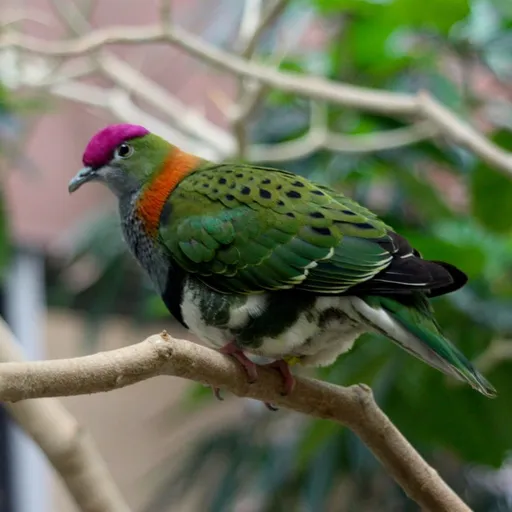
Superb Fruit Dove
Ptilinopus superbus
Least Concern
Overview
The superb fruit dove (Ptilinopus superbus), also known as the purple-crowned fruit dove, is a medium-sized, colourful member of the pigeon and dove family found across Australasia. Although classified as Least Concern globally by the IUCN, the species faces threats from habitat loss and is considered vulnerable in New South Wales, Australia.
Identification
- Males possess a fiery orange nape, green ears, and a purple crown, while females are predominantly green with a white abdomen and light blue breast.
- Both sexes feature yellow eyes and eye-rings, and males display a grey breast separated from the abdomen by a wide, dark blue band.
- Medium-sized at 22–24 cm long, with olive green wings covered in dark spots and a white-tipped tail.
- Wings emit a whistle when in flight, accompanied by a call consisting of a steady coo-coo-coo-coo.
Habitat
Native to the rainforests of New Guinea, Australia, the Solomon Islands, the Philippines, and Sulawesi in Indonesia. In Australia, its range extends from southern New South Wales around Moruya northwards to Cape York in Queensland, where it becomes more common. In marginal or seasonal habitats such as Australia, flocks move to follow food availability, whereas it remains a resident species in areas like the New Guinean rainforest.
Diet
Primarily feeds on fruits and berries, with figs, Canarium australianum drupes, and various palm fruits forming a large portion of the diet in some regions. It also consumes fruits from cinnamon trees, Litsea, Neolitsea, and Cryptocarya, alongside smaller amounts of ylang-ylang, Syzygium, and Vitex cofassus. The species eats smaller fruits than other fruit doves, with a maximum recorded consumption volume of 2.5 cm³.
Did you know?
During the breeding season, the sexes share incubation duties for the single white egg, with the male taking his turn during the day while the female incubates at night.
Sources
- Wikipedia · CC BY-SA 4.0
- Wikidata · CC0 1.0