
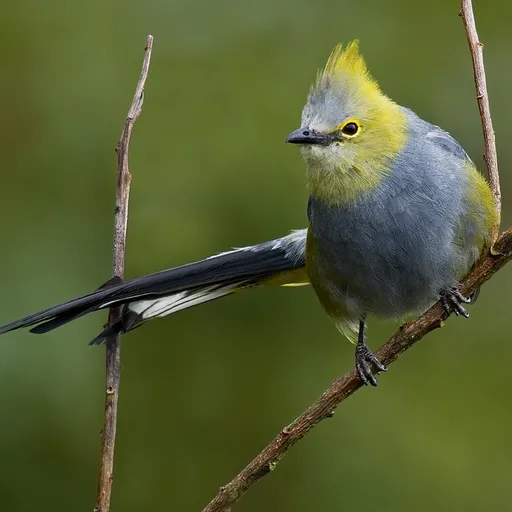
Long-tailed Silky-flycatcher
Ptiliogonys caudatus
Least Concern
Listen
XC459109 · Oliver Komar · Nueva California, Bugaba, Provincia de Chiriquí, Panama · CC BY-SA 4.0
Overview
The long-tailed silky-flycatcher (Ptiliogonys caudatus) is a passerine bird in the family Ptiliogonatidae, native to highland regions of Costa Rica and Panama. Classified as Least Concern by the IUCN, it is considered a fairly common year-round resident in its range.
Identification
- A slender bird 20 to 24.4 cm long with a prominent crest and a very long tail, where the central feathers extend beyond the others.
- Males feature a grey forehead and crown, a yellowish olive-green face and crest, and bluish-grey backs; both sexes have black bills and legs with a black tail featuring large white central patches.
- Vocalisations are described as a 'wooden and staccato chittering', a 'sharp, dry che chip', or a 'bell-like tinkling note' reminiscent of loose pebbles in a box.
Habitat
Found in the Cordillera Central in central Costa Rica and the Cordillera de Talamanca extending into western Panama, the species inhabits somewhat open subtropical and temperate landscapes such as primary and secondary forest edges, pastures with scattered trees, and gardens. Its elevational range varies between 1,600 m and 3,000 m, with populations separated by deep river valleys where the bird is absent.
Diet
This species feeds on insects and small fruits, plucking fruit at any level of its habitat while perched. It captures insects in mid-air from high perches, often gathering several prey items in a single sortie.
Did you know?
The nest is a bulky open cup constructed primarily from Usnea lichen held together with spider web, typically placed 2 to 18 m above the ground in a branch fork.
Sources
- Wikipedia · CC BY-SA 4.0
- Wikidata · CC0 1.0