
Paradise Riflebird
Ptiloris paradiseus
Overview
The paradise riflebird (Ptiloris paradiseus) is a passerine bird belonging to the family Paradisaeidae. It is one of four species within the genus Ptiloris and is characterised by its striking sexual dimorphism. This species is primarily found in the subtropical and temperate rainforests of eastern Australia.
Identification
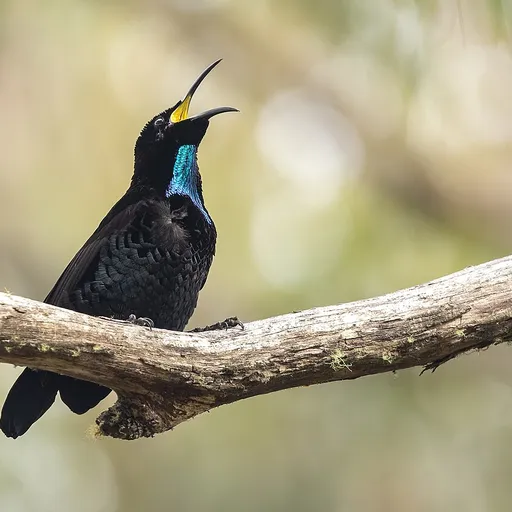
- Males are black with iridescent blue-green patches on the crown, throat, central tail feathers, lower breast, and flanks, while females are gray-brown with rufous wings, a white supercilium, and a barred white throat.
- Both sexes possess a long, black, decurved bill, black legs, and dark brown irises, though the bill is notably longer and more decurved in females.
- Males produce a powerful, growling 'yaassss' call that is often repeated once at a time and lasts around two seconds.
Habitat
Endemic to eastern Australia from New South Wales to Queensland, the paradise riflebird inhabits rainforests, typically residing in the canopy above 500 m elevation. It is a sedentary species with low population density, though it may move to lower elevations, sometimes below 200 m, or shift to nearby sclerophyll forests during winter.
Diet
This species is both frugivorous and insectivorous, mainly feeding on insects and fruit found high in the forest canopy. It is normally a solitary and dispersed forager, but occasionally individuals may form aggregations of six to seven birds.
Did you know?
Some of the male's feathers are 'super black', with barbules structurally modified to absorb light, creating optical illusions that exaggerate the brightness of adjacent iridescent patches during courtship displays.